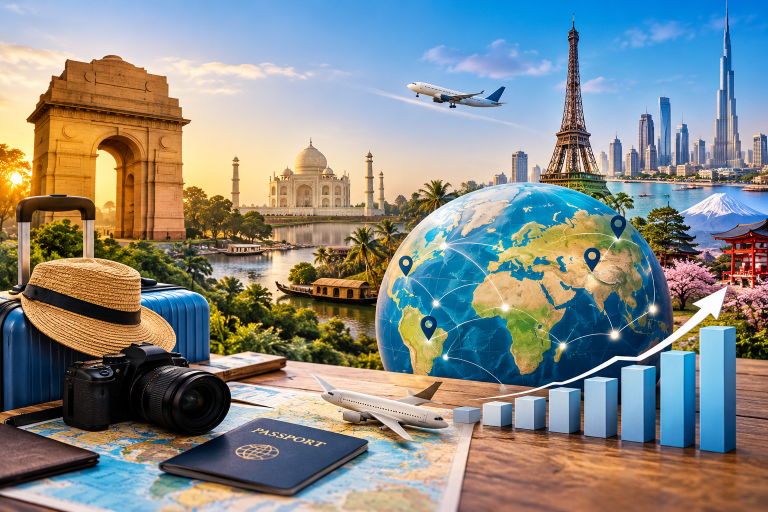
Noctourism: When the sun dips below the horizon and towns begin to sparkle with lights, the noctourist—a new kind of traveler wakes. Forget early morning tours and packed daylight trips; noctourism is about seeing a place after dark, when the planet slows down, lights glisten, and cultures also reveal a side often hidden from sunshine.
From moonlit temple celebrations in Asia to nighttime safaris in Africa and stargazing beneath polar skies, the night is today a time for exploration rather than for rest. Often referred to as noctourism, this growing trend is altering how we see travel and turning night into spectacular experiences.
The expansion of nocturnal tourism
Travel has always unlocked daylight. Most events are intended for the 9-to-5 traveler: museums, guided tours, and monuments. But as global travel evolves, the boundaries of discovery are going into the shadows.
Post-pandemic, travelers have sought extraordinary, under-crowded, sensorially rich experiences. The result? An increase in noctourism—travel arranged around evening activities offering serenity, authenticity, and maybe a bit of mystery. Originally reserved for rest, the dark hours now draw adventure seekers to investigate the world illuminated by stars, metropolitan lights, or moonbeams.
Since 2022, demand for off-peak travel—which encompasses nighttime tourism—has increased by 40%, according to the World Tourism Organization. Rather than only schedules, travelers crave ambience. Still, nothing is more evocative than the seduction of the evening.
Why Visitors Pick the Night
The causes of noctourism’s growth are as intriguing as the experiences themselves. More connected, inquisitive, and introspective, the modern traveler searches for something beyond the usual.

1. Escaping the Crowd:
At night, imagine seeing Rome’s Colosseum or Kyoto’s temples quiet, brilliantly lighted, and almost religious. Night tours let visitors discover famous sites without the morning traffic.
2. Improved Senses:
Other senses come alive as vision is somewhat restricted. Noctourism transforms travel into a sensory experience: the scent of night-blooming jasmine, the texture of cold sand beneath feet, and the chirping of nocturnal animals.
3. Romantically and mystically appealing:
The evening has always had a mystical enchantment. The darkness creates a sense of intimacy and marvel, whether it is a moonlit cruise on the Seine or viewing the Northern Lights in Finland.
4. Cultural Relationship:
From Ramadan’s night markets to India’s all-night temple festivals and Thailand’s lantern celebrations, many societies honor their most significant customs following sunset. Night travel lets tourists develop a closer bond with local life.
Legendary Noctourism Encounters Across the Globe
Let’s explore some of the most fascinating nighttime adventures in the world—experiences that demonstrate how travel after dark may be as beautiful, if not more so, than during the day.
1. Star-bathing in Finland
Darkness is present far north in Finnish Lapland. Starbathing, or lying beneath the open sky absorbing the energy of the stars, has become a favorite pastime here. From glass igloos in Kakslauttanen to aurora huts by frozen lakes, visitors come not only to see the Northern Lights but also to experience them.
Star-bathing is engaging, unlike stargazing. Wrapped in silence, picture yourself descending into a warm outdoor bath as the Milky Way stretches itself across the heavens. It’s a meditative link with the cosmos, not just a perspective.
2. Singapore and Kenyan nighttime safaris
The jungle wakes in Africa when the sun sets.
Leopards stalking, hyenas yelling, and elephants walking across the Savannah like shadows provide a window into the hidden activities of nocturnal animals.
Guided night drives in Kenya’s Maasai Mara expose events that daytime safaris overlook. The thrill rests not in the promise of seeing but in the mystery of darkness—where every rustle might be something amazing.
Through its renowned Night Safari, the first nocturnal zoo in the world, Singapore has also adopted noctourism. Visitors stroll here along weakly lit pathways meant to mirror moonlight among more than 2,500 nighttime world critters.
3. Asian Moonlit Cultural Celebrations
Long celebrating the night via events combining religion, creativity, and society, Asia has also
• Loy Krathong (Thailand): Each carrying a desire and moonlight reflection, thousands of drifting lanterns flow throughout rivers.
• Kumbh Mela’s Night Aartis in India sees worshipers congregate on the riverbanks, singing hymns under flashing lights over the sea.
– In one of Japan’s most peaceful evening customs, paper lanterns help ancestral spirits return to the underworld.
These celebrations turn the evening into something holy—not just a period but also a sensation.
4. City Skylines and Nocturnal Walks
Urban noctourism is growing at an explosive rate. Cities like Paris, New York, Tokyo, and Dubai now sponsor guided night walks and rooftop events aiming to expose a lighter, more ethereal aspect of city living.
• Twilight walks over the Seine or late-night jazz bars in Paris capture the city’s amorous beat.
– Desert night safaris in Dubai conclude with sessions of stargazingin total quiet.
• After sunset, the neon-lit Shinjuku area of Tokyo turns into a photographer’s dream.
• Night bike tours over the Brooklyn Bridge provide spectacular skyline views in New York.
These events change city travel by turning the night itself into the draw.
5. Nights in the deserts of Morocco and the UAE
Not many experiences compare with desert camping under a star blanket. The Moroccan Sahara and the Liwa Desert in the UAE are excellent noctourism sites.
Hypnotic is the dunes’ stillness, broken only by a far-off drumming or the faint wind. Midnight storytelling, stargazing with telescopes, and moonlit camel journeys—experiences that slow time and deepen the spirit—are offered at many camps today.
The Technologies Behind Noctourism
Notably, the development of noctourism corresponds with developments in travel technology. Modern apps and AI-powered technologies are simplifying nighttime exploration more than ever.
Roam Around and Vacay, among other AI itinerary planners, organize safe and optimized nighttime schedules according to weather, location, and individual inclination.
• Smart wearables improve visibility and safety for cyclists or nocturnal trekkers.
• With remarkable clarity, travelers can capture the magic of darkness using smartphone tools like Night Mode or settings for astrophotography.
Technology guarantees that nighttime excursions remain immersive—not scary.
The difficulties of noctourism
Though noctourism is exciting, it has difficulties. For this trend to flourish sustainably, safety, access, and environmental issues have to be solved.
1. Security Issues:
After dusk, searching calls for increased alertness. Local rules, places to avoid, and transportation choices should be carefully noted by travelers.
2. Environmental Effects:
Excessive artificial lighting on nighttime excursions may upset nighttime species. Good tourism guarantees little ecological disturbance.
3. Cultural Sensitivity:
Night tourism is not accepted in every community. Travelers should abide by local traditions, like avoiding sacred places after dark.
4. Logistical Constraints:
Particularly in isolated locations, public transportation, hotel check-ins, and service availability may be restricted at night.
Embracing noctourism safely and sustainably calls for some planning.
Should you find the notion of discovering after dusk intriguing, consider these wise recommendations:
• Investigating Select respectable guides or businesses concentrating on nighttime excursions beforehand.
Your evening buddies are a first-aid kit, power bank, and flashlight.
• Respect wildlife and residents: Silence is gold; so is sensitivity.
• Choose Eco-Friendly Experiences: Many tours today use low-impact lighting or highlight natural darkness.
• Use AI-powered maps or itineraries, but let intuition and local wisdom guide your trip—thereby fusing human interaction with technology.
Noctourism and the human spirit
Noctourism is really about feeling differently, not just seeing things differently. The evening beckons introspection. You start to hear the whispers of nature, the pulse of cities, and the beat of your own heart when the world calms down.
Walking over unfamiliar streets under a silvery moon or seeing fireflies dance above rice fields has a poetic quality. It is travel stripped of diversion, illuminated only by courage and curiosity.
One noctourist brilliantly stated:
“The night reveals another facet of the world; it doesn’t conceal it.”
Noctourism’s future
Noctourism offers a link between tranquility and adventure as sustainability and personalization continue to shape the direction of travel. Governments and travel boards are already sinking money into “Dark Sky Parks,” regions where artificial light is reduced so that natural nightscapes may thrive.
Promoting astro-tourism and nocturnal eco-lodges are destinations such as New Zealand, Iceland, and the Atacama Desert of Chile. Even cities are getting on board with safe “night trails,” 24-hour museums, and moonlit walking tours.
The message is quite obvious: the night is the main act, not a break between days.
Conclusion: Chasing the Moon’s Magic
In a world that seldom stops, noctourism provides something priceless: stillness. It’s the most personal kind of travel, when shadows tell tales and stars become guides. The night offers adventures for those ready to enter its mystery, whether it be star-bathing in Finland, exploring Moroccan deserts, or dancing beneath Thai lanterns.
Therefore, next time you travel, resist rushing back to your hotel as dusk descends. Step outside instead.
Hear.
Look up.
The world after dark has a rhythm of its own; it is waiting for you to find it.
Further Reading
https://ugcnettourism.in/ai-itineraries-letting-artificial-intelligence-plan-the-perfect-trip/