Discover how a virtual classroom with VR and AI is reshaping education through immersive learning, personalized teaching, and global collaboration
Education has always been about connection — between teachers and students, ideas and imagination, knowledge and curiosity. But today, that connection is being reshaped in ways we couldn’t have imagined just a decade ago. With a virtual classroom with VR and AI, learning is no longer bound by walls, chalkboards, or even geography.
This isn’t about gadgets or hype. It’s about creating experiences that feel alive, supportive, and accessible to everyone.
1. Learning That Adapts to You
Every student learns differently. Some grasp concepts quickly, while others need more time and practice. Traditional classrooms often struggle to keep up with these differences.
This is where AI steps in. In a virtual classroom with VR and AI, smart systems can track a student’s progress, highlight areas of difficulty, and adjust lessons in real time. Imagine having a digital tutor who knows exactly when you need extra help and when you’re ready to move ahead.
For example, a student struggling with fractions might receive extra practice problems, while another who has mastered them moves on to algebra. This kind of personalization ensures that no one is left behind, and every learner feels supported.
2. Turning Lessons Into Experiences
Reading about the solar system is one thing. Walking through it in VR is another. Virtual reality makes abstract ideas tangible and unforgettable.
In a virtual classroom with VR and AI, students don’t just read about history — they explore ancient civilizations by “walking” through reconstructed cities. They don’t just memorize formulas — they conduct science experiments in a safe digital lab. They don’t just repeat phrases — they practice speaking a new language in a simulated cultural setting.
The result? Learning becomes an adventure, not a chore. Instead of memorizing facts, students experience them. This hands‑on approach improves retention, sparks curiosity, and makes lessons far more memorable.
3. Breaking Down Borders
Education should be universal, but geography often limits opportunities. A virtual classroom with VR and AI erases those boundaries and makes global learning possible.
Picture this: a student in India collaborating with peers in Europe, attending lectures from professors in the U.S., and sharing projects in real time — all without leaving home. This global exposure builds cultural understanding, teamwork skills, and a sense of community.
In today’s world, where collaboration across borders is increasingly important, a virtual classroom with VR and AI prepares students for the future workplace, where global teams are the norm.
4. Affordable Training for Complex Skills
Higher education and professional training often require expensive equipment and complex setups. A virtual classroom with VR and AI offers a cost‑effective alternative that makes advanced learning more accessible.
- Medical students can practice surgeries in virtual operating rooms without the risks of real patients.
- Engineers can test prototypes in digital labs before investing in physical models.
- Corporations can train employees in safe, simulated environments that replicate real‑world challenges.
This approach saves money, reduces risks, and gives learners hands‑on experience that feels authentic. For institutions, it means offering high‑quality training without the financial burden of physical equipment. A virtual classroom with VR and AI bridges the gap between affordability and excellence, ensuring that advanced skills are within reach for everyone.
le.
5. Challenges We Need to Address
Of course, no transformation comes without hurdles. Even a virtual classroom with VR and AI faces practical challenges that must be addressed:
- Cost of devices like VR headsets, which can be expensive for schools and families.
- Digital divide in under‑resourced regions, where access to reliable internet and devices is limited.
- Teacher training, since confidence with technology is essential for effective use.
- Data privacy concerns with AI systems, ensuring that student information remains secure.
These challenges are real, but they’re also solvable. Governments, schools, and tech companies can work together to make sure a virtual classroom with VR and AI is accessible to all, not just a privileged few.
6. Emotional Impact on Students
Technology isn’t just about efficiency; it’s about emotion. At the heart of every learning journey are feelings — curiosity, confidence, and joy. A virtual classroom with VR and AI taps into these emotions, making education not only effective but also deeply human.
- Confidence for shy learners: Students who hesitate to speak up in traditional classrooms often find their voice in safe, simulated environments. Practicing presentations in VR reduces anxiety, allowing them to build confidence step by step.
- Encouragement for nervous learners: AI acts like a patient mentor, offering personalized guidance. When a learner struggles, the system provides gentle nudges, extra practice, and positive reinforcement, helping them feel supported rather than judged.
- Joy of discovery: Instead of passively reading about volcanoes, students can “stand” inside one through VR. Instead of memorizing dialogues, they can practice conversations in a virtual café. These immersive experiences spark wonder and make learning unforgettable.
- Sense of belonging: In a virtual classroom with VR and AI, students collaborate across borders, share projects, and celebrate achievements together. This builds community and reduces feelings of isolation, especially for remote learners.
- Emotional resilience: By facing challenges in simulated environments, students learn to manage stress and adapt to new situations. This prepares them not just academically, but emotionally for real‑world scenarios.
Ultimately, the emotional impact of a virtual classroom with VR and AI is what makes it transformative. It turns lessons into experiences, and experiences into memories that shape a student’s confidence, curiosity, and lifelong love for learning.
7. Teacher Perspectives
Teachers remain at the heart of education. Far from replacing them, a virtual classroom with VR and AI empowers teachers to do what they do best — inspire, mentor, and guide.
- Bringing lessons alive: A teacher in a virtual classroom with VR and AI can transport students into historical events, scientific experiments, or cultural experiences that textbooks alone cannot capture. Imagine walking through the streets of ancient Rome or observing a chemical reaction in a safe, simulated lab — all guided by the teacher’s expertise.
- More time for mentoring: AI can automate repetitive tasks like grading quizzes, tracking attendance, or generating progress reports. This frees teachers to spend more time on one‑to‑one mentoring, personalized feedback, and emotional support for students.
- Enhanced creativity: VR tools allow teachers to design interactive lessons that spark curiosity. Instead of lecturing about ecosystems, they can take students inside a rainforest. Instead of explaining geometry, they can let learners manipulate 3D shapes in real time.
- Professional growth: Teachers themselves benefit from AI analytics, which highlight classroom trends and student needs. This helps them refine their teaching strategies and continuously improve.
- Technology as a partner: In the end, technology doesn’t compete with teachers — it complements them. A virtual classroom with VR and AI becomes a collaborative space where human empathy and digital innovation work hand in hand.
By blending their wisdom with the power of immersive tools, teachers remain the true architects of learning. Technology simply gives them new ways to reach hearts and minds.
8. The Human Side of Technology
It’s easy to get caught up in the excitement of new tools, but at its core, education is about people. Teachers remain central to the learning process. A virtual classroom with VR and AI doesn’t replace them — it empowers them.
A teacher using VR can bring history alive in ways textbooks never could. AI can free teachers from repetitive grading tasks, giving them more time to focus on mentoring and inspiring students.
Technology becomes a partner, not a substitute.
9. Future Career Preparation
Tomorrow’s jobs demand skills that traditional classrooms often struggle to teach. Industries are evolving rapidly, and employers now expect graduates to arrive with not just theoretical knowledge, but practical, hands‑on experience. This is where a virtual classroom with VR and AI becomes a game‑changer.
- Medical training: In a virtual classroom with VR and AI, medical students can practice surgeries in lifelike simulations. They learn to respond to emergencies, handle complex procedures, and build confidence before stepping into real operating rooms.
- Engineering and design: Engineers can test prototypes in digital labs, experiment with materials, and simulate stress tests without the cost of physical models. This prepares them for innovation in industries like aerospace, automotive, and construction.
- Creative industries: Artists, designers, and filmmakers can explore immersive worlds, experiment with 3D modeling, and collaborate globally. A virtual classroom with VR and AI nurtures creativity while providing tools that mirror professional environments.
- Soft skills development: Beyond technical expertise, students also practice teamwork, communication, and problem‑solving in collaborative VR spaces. AI feedback helps them refine presentations, leadership skills, and adaptability — qualities essential in modern workplaces.
- Global career readiness: Since many companies now operate across borders, students trained in a virtual classroom with VR and AI gain exposure to multicultural collaboration. They learn to work in diverse teams, preparing them for international careers.
By the time students graduate, they don’t just carry degrees — they carry experiences. A virtual classroom with VR and AI ensures they are career‑ready, confident, and equipped with skills that match the demands of tomorrow’s workforce.
10. Case Studies and Success Stories
Sometimes the best way to understand the power of a virtual classroom with VR and AI is to look at real examples. Around the world, schools, universities, and companies are already using these tools to make learning more effective.
- Stanford University: Medical students here use VR labs to practice surgeries. Instead of waiting to work on real patients, they can rehearse complex procedures in a safe, virtual environment. This builds confidence and reduces mistakes when they step into actual operating rooms.
- Indian Schools: Many schools in India are testing AI‑powered language apps. These apps help children learn English and local languages at their own pace. The AI adjusts lessons depending on how quickly a student is learning, making education more personalized.
- Global Corporations: Companies across the world rely on VR simulations to train employees. For example, airline staff can practice safety drills in virtual cabins, and factory workers can learn how to handle machinery without any risk. This saves money and keeps training safe.
These stories show that the virtual classroom with VR and AI is not just an idea for the future — it’s already happening today. From universities to schools to workplaces, people are experiencing the benefits of immersive and personalized learning.
11. Ethical and Social Considerations
Technology must be used responsibly. A virtual classroom with VR and AI raises questions about data privacy, screen time balance, and equitable access.
Communities must ensure that innovation bridges gaps instead of widening them.
12. Tips for Schools Ready to Try VR & AI
Adopting new technology can feel overwhelming, but with the right approach, schools can make the transition smooth and impactful. Here are some practical tips for institutions ready to explore a virtual classroom with VR and AI:
- Start small: Begin with pilot programs in one subject or grade level before scaling up. This helps schools test what works best and gather feedback without overwhelming teachers or students.
- Train teachers: Confidence with technology makes all the difference. Workshops and hands‑on training sessions ensure teachers feel comfortable using VR headsets and AI tools in everyday lessons.
- Ensure accessibility: Shared devices, low‑cost options, or community partnerships can help bridge gaps for schools with limited budgets. A virtual classroom with VR and AI should be inclusive, not exclusive.
- Focus on engagement: Use VR where visuals and interaction add the most value — like science experiments, history tours, or language practice. AI can personalize these experiences, keeping students motivated.
- Monitor progress: AI analytics can track student outcomes, highlight areas of improvement, and refine teaching approaches. This ensures that schools get measurable benefits from their investment.
By following these steps, schools can gradually build confidence, ensure inclusivity, and unlock the full potential of a virtual classroom with VR and AI.
13. Student Voices
At the heart of every classroom are the students. Their voices tell the real story.
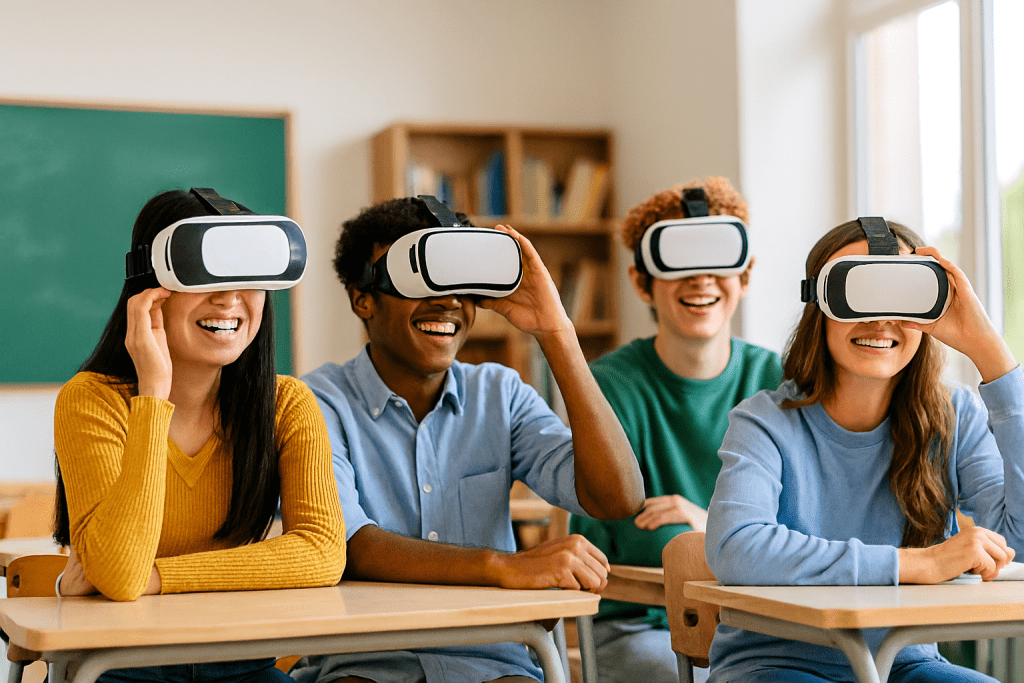
One student might say: “It feels like I’m inside the lesson, not just reading about it.” Another might share: “I used to be nervous about speaking English, but practicing in a virtual café made me confident.”
These reflections show the emotional impact of a virtual classroom with VR and AI — curiosity, confidence, and joy that extend beyond grades.
14. Looking Ahead: Metaverse Classrooms
What comes after VR and AI? The answer may lie in the metaverse — a digital universe where learning feels limitless. While a virtual classroom with VR and AI has already transformed how students experience lessons, the metaverse takes this vision even further.
- Holographic teachers: Imagine a teacher appearing as a lifelike hologram in your living room, guiding you through lessons as if they were physically present. This makes learning more personal and interactive.
- Global collaboration in real time: Students from different countries could share the same virtual space, working on projects together, attending debates, or even exploring museums and cultural landmarks side by side.
- Immersive campuses: Instead of logging into a video call, learners could “walk” through digital campuses, attend lectures in virtual auditoriums, and join study groups in 3D environments.
- Limitless resources: The metaverse could host libraries, labs, and creative studios that are accessible anytime, anywhere. Students would no longer be restricted by physical infrastructure.
- Blending reality and imagination: Lessons could combine real‑world data with imaginative simulations. For example, climate science classes could let students visualize rising sea levels in their own city, making learning both urgent and impactful.
The virtual classroom with VR and AI is just the beginning of this journey. As the metaverse evolves, education may become a truly borderless, immersive, and collaborative experience — one where learning is not confined to a screen, but lived as an adventure.
Conclusion
Virtual classrooms aren’t science fiction anymore — they’re happening now. By blending AI’s adaptability with VR’s immersive power, education is becoming more engaging, inclusive, and inspiring.
The promise of a virtual classroom with VR and AI is simple: to make learning immersive, personalized, and inspiring for every student.