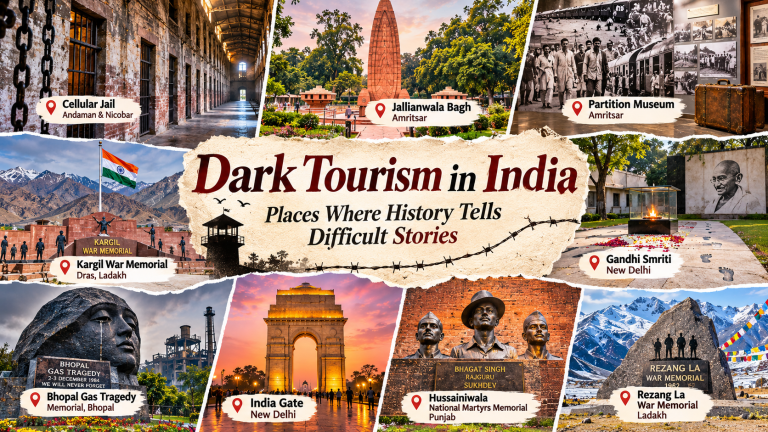
India is home to magnificent monuments, ancient temples, beautiful landscapes, and vibrant cultural destinations. However, some of its most meaningful historical places are connected to painful events, human suffering, colonial oppression, war, displacement, and tragedy.
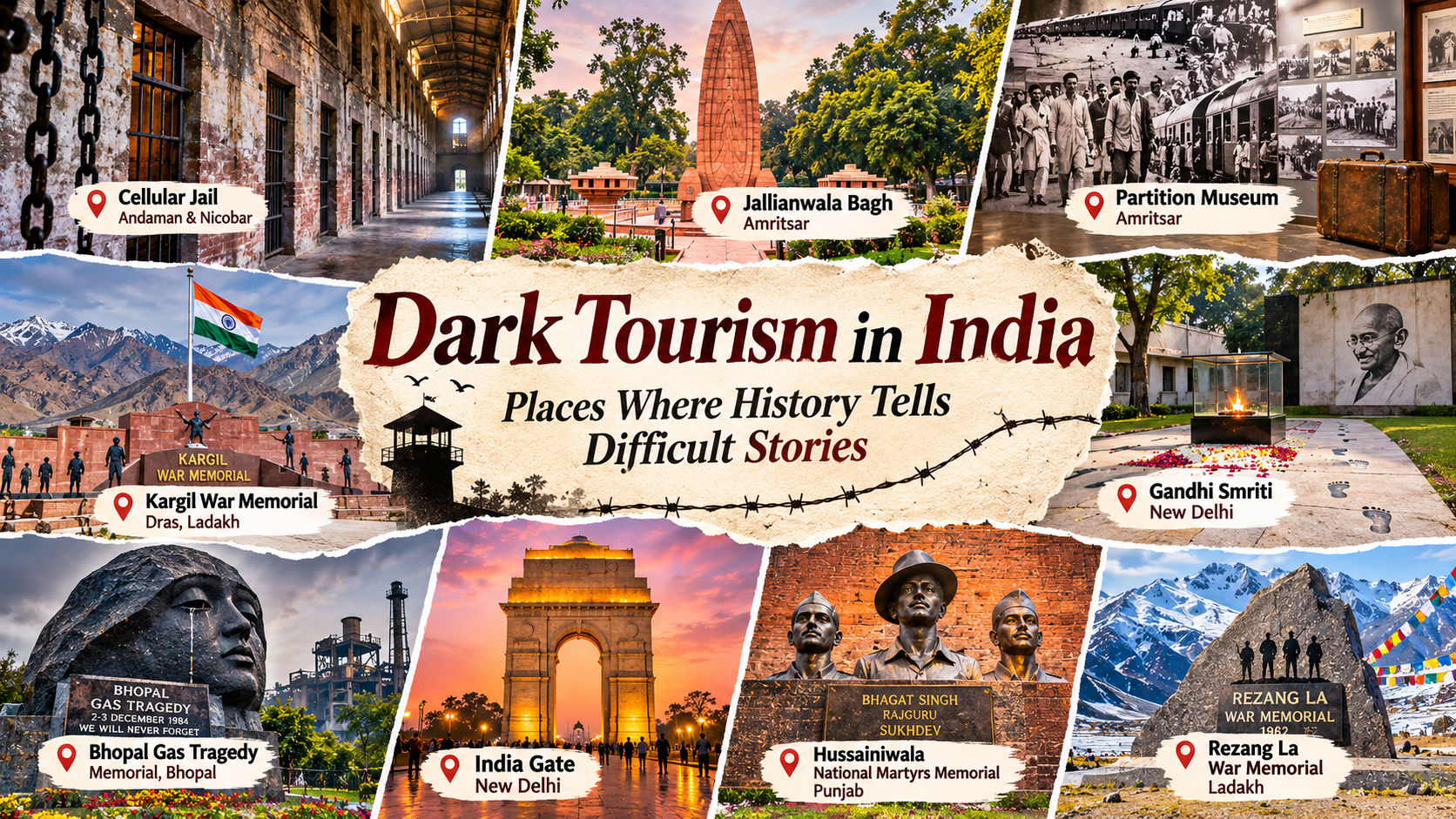
Dark tourism in India offers an opportunity to explore these difficult chapters of history through memorials, museums, preserved sites, and places of remembrance. From the colonial prison of Cellular Jail in the Andaman Islands to the Jallianwala Bagh massacre memorial and the Partition Museum in Amritsar, these destinations encourage visitors to reflect on the human experiences behind historical events.
Unlike conventional sightseeing, dark tourism is not about entertainment or sensationalising suffering. It is about understanding history, remembering victims, honouring courage, and learning how societies respond to tragedy.
In this article, we explore some of the most significant dark tourism destinations in India and the difficult stories they preserve.
What Is Dark Tourism?
Dark tourism refers to travel to places associated with death, tragedy, conflict, suffering, and historical disasters. These destinations may include former prisons, war memorials, disaster sites, massacre locations, and museums documenting traumatic events.
In India, dark tourism is closely connected with the country’s freedom struggle, Partition, military conflicts, political violence, and industrial disasters.
These destinations serve an important educational purpose. They help visitors understand the consequences of violence, the importance of human rights, and the value of peace and freedom.
1. Cellular Jail, Andaman and Nicobar Islands – The Prison of Colonial Oppression
Located in Sri Vijaya Puram, formerly Port Blair, Cellular Jail is one of India’s most powerful historical memorials. Constructed by the British between 1896 and 1906, it was designed around the panopticon principle, allowing guards to observe prisoners from a central tower.incredibleindia.gov+1
The prison became infamous for its solitary confinement cells, harsh punishments, and forced labour. It was built to hold hundreds of Indian freedom fighters in individual cells, preventing communication between them.prod.incredibleindia.gov+1
The jail became known as Kala Pani, or “Black Water,” reflecting the isolation and suffering associated with transportation across the sea to the remote Andaman Islands.incredibleindia.gov+1
Why is it important for dark tourism?
The Cellular Jail National Memorial preserves the physical structure of colonial imprisonment. Visitors can explore surviving prison wings, galleries, photographs, and historical exhibits documenting the freedom struggle.
The light-and-sound programme narrates the experiences of prisoners and the history of resistance against colonial rule.
Visitor experience: Explore the prison galleries, read historical accounts, and visit the memorial with time for reflection.
Location: Sri Vijaya Puram, Andaman and Nicobar Islands.incredibleindia.gov+1
2. Jallianwala Bagh, Amritsar – Remembering the Massacre of 1919
Jallianwala Bagh is one of the most significant memorial sites associated with India’s freedom movement.
On 13 April 1919, British troops under Brigadier-General Reginald Dyer fired upon a gathering of people in the enclosed garden in Amritsar. The massacre became a defining moment in India’s struggle against colonial rule.amritsar.nic+1
The Amritsar district administration notes that the memorial commemorates around 2,000 Indians who were killed or wounded during the firing. The incident caused widespread outrage and deeply affected the national movement for independence.amritsar.nic
What can visitors see?
The memorial preserves historical features associated with the massacre, including:
- Sections of the wall bearing bullet marks.
- The Martyrs’ Well, where people tried to escape the firing.
- Memorial structures and landscaped grounds.
- Exhibits documenting the massacre and its historical significance.amritsar.nic+1
The site encourages visitors to understand the consequences of colonial repression and the importance of civil liberties.
Visitor experience: Walk through the memorial grounds, explore the historical gallery, and learn about the events of 1919.
Location: Amritsar, Punjab.amritsar.nic+1
3. Partition Museum, Amritsar – The Human Stories of India’s Partition
The Partition of India in 1947 was one of the most traumatic events in South Asian history. The division of British India into India and Pakistan resulted in mass displacement, violence, separation of families, and the loss of homes and livelihoods.
The Partition Museum in Amritsar preserves the memories of people who experienced this upheaval. Located in the historic Town Hall, it opened to the public on 25 August 2017.incredibleindia.gov
Rather than focusing only on political decisions, the museum documents the human consequences of Partition through personal belongings, photographs, documents, artwork, and oral histories. Its collection includes more than 100 oral interviews and multimedia exhibits.incredibleindia.gov
Why visit?
The museum helps visitors understand:
- The displacement of millions of people.
- The experiences of refugee families.
- The loss of homes and ancestral communities.
- The emotional consequences of migration.
- The resilience of survivors rebuilding their lives.
Visitor experience: Explore galleries, listen to oral histories, and reflect on the experiences of families affected by Partition.
Location: Historic Town Hall, Amritsar, Punjab.incredibleindia.gov+1
4. Gandhi Smriti, New Delhi – The Place Where Mahatma Gandhi Was Assassinated
Gandhi Smriti, located at the former Birla House on Tees January Marg, preserves the memory of Mahatma Gandhi’s final days.
Mahatma Gandhi lived here during the last months of his life. On 30 January 1948, he was assassinated while proceeding towards the prayer ground.
The memorial preserves the room where Gandhi stayed and the prayer ground where he was shot.
What makes this destination significant?
Gandhi Smriti provides an opportunity to understand the life, philosophy, and final days of one of India’s most influential leaders.
The Martyr’s Column marks the place associated with his assassination, while the museum displays photographs, personal belongings, artworks, and historical material.
Visitor experience: Explore the preserved room, walk towards the Martyr’s Column, and learn about Gandhi’s ideas of non-violence, peace, and communal harmony.
Location: 5, Tees January Marg, New Delhi.
5. Kargil War Memorial, Dras – Remembering the Soldiers of 1999
Located in Dras, Ladakh, the Kargil War Memorial commemorates Indian soldiers who lost their lives during the 1999 Kargil War.
The memorial stands against the dramatic Himalayan landscape, with views towards important battle locations, including Tololing and Tiger Hill.
The war involved intense fighting in high-altitude terrain and became a significant chapter in India’s contemporary military history.
What can visitors explore?
- Memorial walls bearing the names of fallen soldiers.
- The commemorative structure and grounds.
- A museum with photographs, artefacts, and military equipment.
- Exhibits describing Operation Vijay.
- Historical accounts of soldiers and their experiences.
Visitor experience: Visit respectfully, read the memorial inscriptions, and understand the challenges faced by soldiers in extreme Himalayan conditions.
Location: Dras, approximately 60 km from Kargil, Ladakh.
6. Bhopal Gas Tragedy Memorials – Remembering an Industrial Disaster
The Bhopal Gas Tragedy remains one of the world’s most devastating industrial disasters.
During the night of 2–3 December 1984, toxic gas leaked from the Union Carbide pesticide plant in Bhopal. The disaster caused thousands of deaths and affected many more people, with long-lasting health and environmental consequences.
The tragedy raised critical questions about industrial safety, corporate responsibility, environmental protection, and the rights of affected communities.
Why is it relevant to dark tourism?
Bhopal’s memorials and remembrance spaces preserve the memory of victims and draw attention to the human consequences of industrial negligence and inadequate safety systems.
The city is also associated with ongoing efforts to document the disaster, support survivors, and preserve collective memory.
Visitor perspective: Any visit should prioritise survivor dignity and historical learning rather than photography or spectacle. The former industrial site should not be assumed to be an open tourist attraction; access restrictions and safety conditions must be respected.
Location: Bhopal, Madhya Pradesh.
7. National Police Memorial, New Delhi – Honouring Those Who Lost Their Lives in Service
The National Police Memorial in Chanakyapuri, New Delhi, honours police personnel who lost their lives in the line of duty.
The memorial recognises sacrifices made while protecting citizens, responding to emergencies, maintaining law and order, and combating terrorism and crime.
What can visitors experience?
The memorial includes the Wall of Valour, which bears the names of police personnel who died in service. Its landscape and central memorial structure create a solemn space for remembrance.
The National Police Museum also presents the evolution of policing in India, the responsibilities of law enforcement, and the challenges faced by personnel.
Visitor experience: Read the memorial inscriptions, explore the museum, and reflect on the human cost of public service.
Location: Chanakyapuri, New Delhi.
8. Hussainiwala National Martyrs Memorial, Punjab – Remembering Bhagat Singh, Rajguru and Sukhdev
Hussainiwala, near Ferozepur in Punjab, is associated with the martyrdom of Bhagat Singh, Rajguru, and Sukhdev.
The three revolutionaries were executed by the British in Lahore on 23 March 1931. Their bodies were secretly transported and cremated near Hussainiwala, across the Sutlej River.
Today, the National Martyrs Memorial commemorates their sacrifice and contribution to India’s freedom struggle.
Why visit?
The site provides an opportunity to understand revolutionary nationalism, colonial repression, and the role of young freedom fighters in India’s independence movement.
Visitor experience: Pay tribute at the memorial and explore the historical context of the revolutionaries’ lives and sacrifices.
Location: Hussainiwala, Ferozepur district, Punjab.
9. Rezang La War Memorial, Ladakh – A Tribute to the Battle of 1962
Rezang La, situated in the high-altitude landscape of Ladakh, is associated with one of the most remembered battles of the 1962 India–China War.
The battle involved soldiers of the Indian Army’s 13 Kumaon Regiment, particularly Charlie Company, under the command of Major Shaitan Singh, who was awarded the Param Vir Chakra posthumously.
The memorial commemorates the soldiers who fought under extremely difficult conditions in freezing temperatures and challenging terrain.
What makes this destination significant?
Rezang La represents courage, military sacrifice, and the human cost of conflict in the Himalayas.
The remote location also highlights the physical and logistical challenges faced by soldiers stationed in high-altitude border regions.
Visitor perspective: Travel to this region requires careful planning, appropriate permissions where applicable, and respect for military and border restrictions.
Location: Near Chushul, Ladakh.
10. Wagah Border – The Historical Legacy of Partition and Division
The Wagah–Attari border is one of the most recognised border crossings between India and Pakistan.
Its significance extends beyond the daily ceremonial lowering of flags. The border represents the geographical division created during Partition in 1947, when the Punjab region was divided between the two countries.
The ceremony attracts visitors interested in military traditions, national identity, and the history of India–Pakistan relations.
Why does it connect with dark tourism?
The border provides a powerful physical reminder of Partition, displacement, and the creation of two nations.
For many families, the division of Punjab meant losing ancestral homes, communities, and access to places deeply connected with their lives.
Visitor experience: Learn about Partition and the border’s history before attending the ceremony. Remember that the event is a contemporary patriotic ceremony, not a direct reconstruction of Partition violence.
Location: Attari, near Amritsar, Punjab.
11. India Gate, New Delhi – A Memorial to Soldiers
India Gate is one of New Delhi’s most recognisable landmarks and a major war memorial.
The monument was constructed in memory of Indian soldiers who died during the First World War and the Third Anglo-Afghan War. The names of soldiers are inscribed on its surfaces.
The memorial has become an important national symbol of military remembrance.
Why visit?
India Gate connects visitors with the history of Indian military service and the sacrifices of soldiers during early twentieth-century conflicts.
Its surrounding landscape and memorial inscriptions provide a setting for reflection on war, remembrance, and national history.
Visitor experience: Explore the monument and its inscriptions, and learn about the historical context of the soldiers commemorated there.
Location: Kartavya Path area, New Delhi.
12. National Memorial and Museum of the Indian Freedom Struggle, Dandi – Remembering the Salt March
Dandi, on Gujarat’s coast, is associated with Mahatma Gandhi’s historic Salt March of 1930.
The march was a major act of civil disobedience against British salt laws and became a powerful symbol of resistance through non-violent action.
The Dandi Salt Satyagraha Memorial commemorates the movement and its participants.
Why is it important?
The destination helps visitors understand how colonial laws, economic control, and political repression shaped the freedom struggle.
The memorial also highlights the role of ordinary citizens in collective resistance.
Visitor experience: Explore the memorial, learn about the Salt March, and reflect on the significance of non-violent protest in modern history.
Location: Dandi, Gujarat.
Why Dark Tourism Matters in India
Dark tourism is more than visiting memorials or historical museums. It can contribute to education, historical awareness, empathy, and responsible remembrance.
1. Preserving difficult histories
Memorials and museums protect historical evidence, personal stories, and memories that might otherwise disappear.
2. Understanding human suffering
Visitors gain insight into the experiences of prisoners, displaced families, soldiers, victims, and survivors.
3. Promoting peace and human rights
Remembering violence and tragedy can encourage discussions about justice, equality, peace, and the prevention of future suffering.
4. Supporting heritage conservation
Responsible tourism can support the preservation of museums, memorials, and historical sites.
5. Encouraging critical historical thinking
These destinations invite visitors to question historical narratives, understand different perspectives, and recognise the complexity of past events.
Responsible Dark Tourism: How to Visit These Places Respectfully
Dark tourism requires sensitivity and awareness.
- Avoid treating tragedy as entertainment: These places are memorials, not amusement attractions.
- Read before visiting: Understand the historical background and significance of the site.
- Respect photography rules: Follow restrictions, especially in museums, memorial galleries, and sensitive areas.
- Respect survivors and local communities: Do not intrude on personal grief or private spaces.
- Avoid sensationalism: Do not create misleading social media content or glorify violence.
- Support conservation: Follow official visitor guidelines and contribute responsibly where appropriate.
- Recognise multiple perspectives: Historical events may be experienced differently by different communities.
Frequently Asked Questions
What is dark tourism in India?
Dark tourism in India involves visiting places associated with historical suffering, war, colonial oppression, political violence, industrial disasters, and memorialisation.
Which is the most famous dark tourism destination in India?
Cellular Jail in the Andaman Islands, Jallianwala Bagh in Amritsar, and the Partition Museum are among India’s most significant destinations associated with dark tourism.incredibleindia.gov+2
Is dark tourism ethical?
Yes, when undertaken respectfully. Dark tourism can support historical education, remembrance, conservation, and empathy. It becomes problematic when suffering is sensationalised or exploited.
Which Indian city is best for dark tourism?
Amritsar is a particularly important destination because it includes Jallianwala Bagh and the Partition Museum, both of which document major traumatic events in Indian history.amritsar.nic+1
Can dark tourism be educational?
Yes. Memorials, museums, and historical sites can help visitors understand the causes and consequences of violence, conflict, displacement, and tragedy.
What is the difference between dark tourism and heritage tourism?
Heritage tourism focuses broadly on cultural, historical, and architectural attractions. Dark tourism specifically explores places connected with death, suffering, tragedy, conflict, and remembrance.
Conclusion
India’s history contains remarkable stories of courage, resistance, sacrifice, and survival, but it also includes chapters of suffering that deserve careful remembrance.
From the solitary cells of Cellular Jail to the preserved memories of Partition, from the battlefields of Ladakh to the memorials of industrial tragedy, these destinations reveal the human consequences of historical events.
Dark tourism in India reminds us that travel is not only about discovering beautiful places—it is also about understanding difficult histories, remembering those who suffered, and learning lessons that remain relevant today.
A responsible visit to these destinations can transform travel into an experience of reflection, empathy, and historical understanding.
References
- Incredible India – Cellular Jail, Sri Vijaya Puram: https://www.incredibleindia.gov.in/en/andaman-and-nicobar-islands/sri-vijaya-puram/cellular-jailincredibleindia.gov
- Incredible India – Colonial Heritage of Andamans and Cellular Jail: https://www.incredibleindia.gov.in/en/andaman-and-nicobar-islands/sri-vijaya-puram/explore-the-fascinating-colonial-heritage-of-andamansincredibleindia.gov
- Press Information Bureau – Cellular Jail: An Embodiment of Sacrifice: https://www.pib.gov.in/newsite/printrelease.aspx?relid=169421pib.gov
- District Amritsar – Jallianwala Bagh: https://amritsar.nic.in/tourist-place/jallian-wala-bagh/amritsar.nic
- Incredible India – Jallianwala Bagh: https://www.incredibleindia.gov.in/en/punjab/amritsar/jallianwala-baghincredibleindia.gov
- Incredible India – Partition Museum, Amritsar: https://www.incredibleindia.gov.in/en/punjab/amritsar/partition-museumincredibleindia.gov
- Partition Museum – Official website: https://www.partitionmuseum.org/partitionmuseum
- Gandhi Smriti and Darshan Samiti – About Gandhi Smriti: https://gandhismriti.gov.in/about-us/gandhi-smriti
- Incredible India – Kargil War Memorial, Ladakh: https://www.incredibleindia.gov.in/en/ladakh/kargil/kargil-war-memorial
- Department of Chemicals and Petrochemicals – Bhopal Gas Leak Disaster: https://chemicals.gov.in/bhopal-gas-leak-disaster
- Incredible India – National Police Memorial, Delhi: https://www.incredibleindia.gov.in/en/delhi/delhi/national-police-memorial
- Ministry of Tourism, Government of India: https://tourism.gov.in/