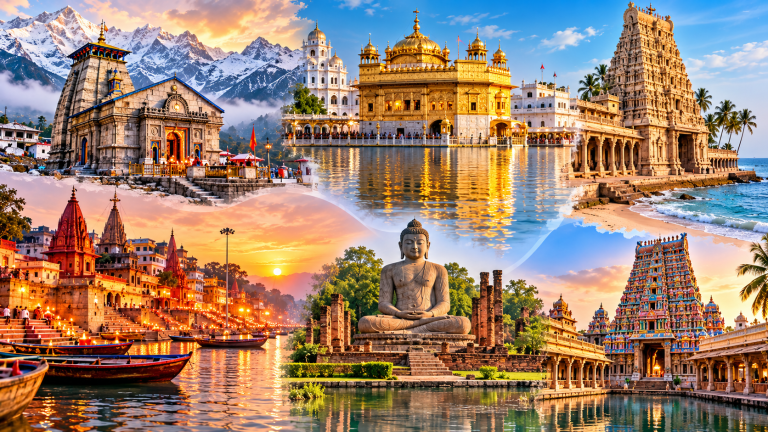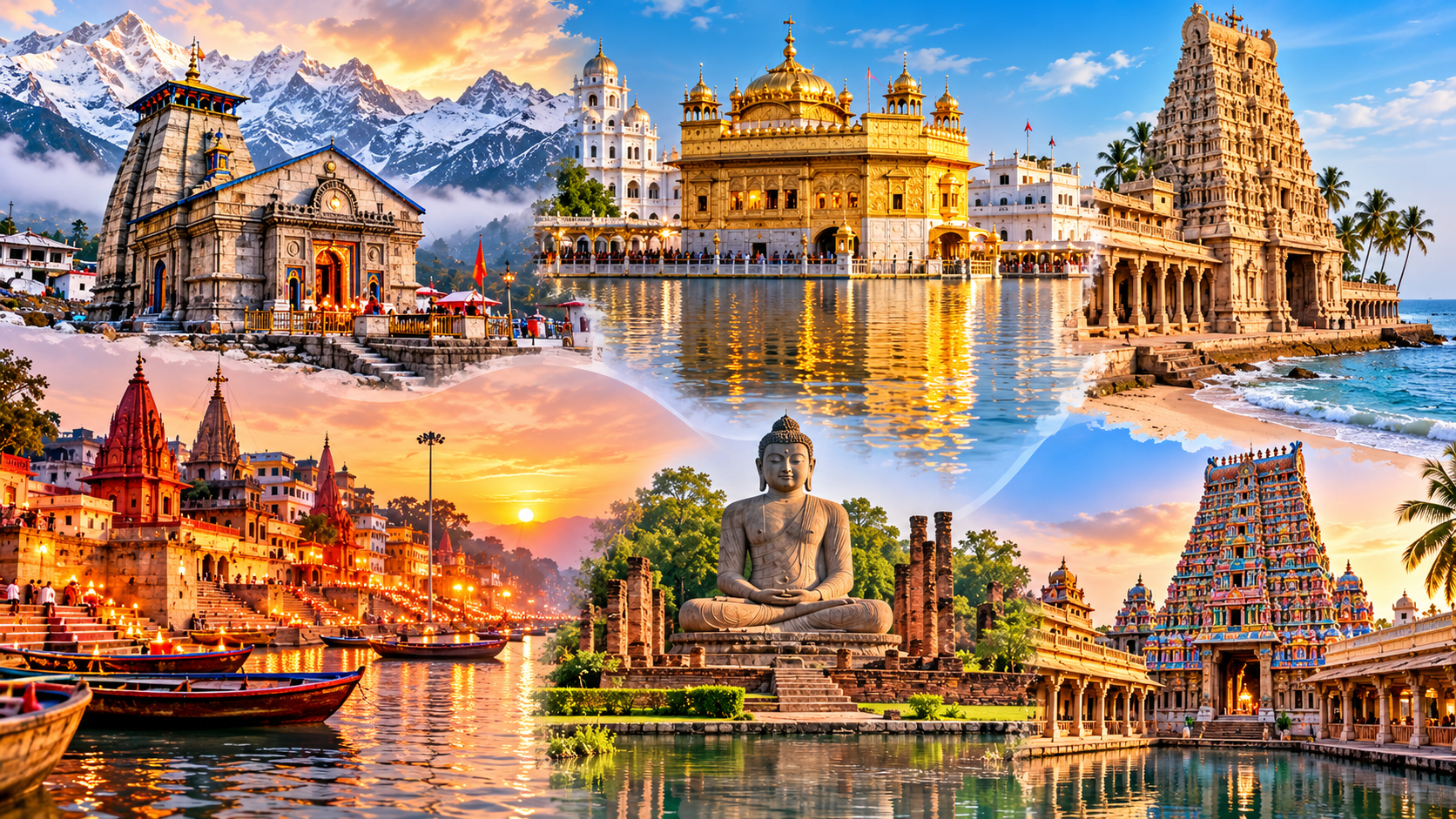
India is a land where travel and spirituality have been connected for thousands of years. Across its vast geography, sacred rivers flow past ancient temples, Himalayan shrines stand surrounded by snow-covered peaks, Buddhist monasteries preserve the teachings of enlightenment, and gurudwaras welcome visitors with the spirit of equality and service. From the sacred ghats of Varanasi to the peaceful surroundings of Bodh Gaya, India’s religious destinations offer experiences that go far beyond conventional sightseeing.
Pilgrimage tourism is one of the most distinctive forms of travel in India. Millions of people undertake journeys every year to seek blessings, fulfil religious vows, explore their spiritual roots, or learn about the country’s diverse faith traditions. Some journeys involve challenging treks through the Himalayas, while others take travellers through historic cities, temple towns, monasteries, and heritage sites.
India’s famous pilgrimage circuits include the Char Dham Yatra, Chota Char Dham, Jyotirlinga circuit, Shakti Peetha circuit, Buddhist circuit, Jain pilgrimage routes, Sikh heritage trail, Sufi destinations, and the magnificent temple circuits of South India.
This guide explores the most important pilgrimage tourism circuits in India, their religious significance, major destinations, suggested routes, ideal travel seasons, and practical tips to help you plan a meaningful journey.
Why Pilgrimage Tourism Is Important in India
Pilgrimage tourism is not simply about visiting religious monuments. It is a journey shaped by faith, tradition, culture, history, and personal experience. A pilgrimage circuit connects several sacred destinations associated with a particular deity, spiritual teacher, religious event, or historical tradition.
For many travellers, these journeys represent devotion and the search for inner peace. For others, they provide an opportunity to understand India’s architecture, local customs, festivals, traditional food, and cultural diversity.
Pilgrimage tourism also contributes to regional economies. Hotels, guesthouses, transport operators, local guides, restaurants, handicraft sellers, and small businesses benefit from visitors travelling to religious destinations. Several government tourism initiatives have also recognised the importance of developing spiritual and thematic tourism circuits, including the Buddhist, Ramayana, Krishna, Tirthankar, and Sufi circuits.
The appeal of pilgrimage tourism can be understood through five important dimensions:
- Religious significance: Sacred sites are connected with deities, saints, spiritual teachers, and important events.
- Cultural heritage: Temples, monasteries, gurudwaras, mosques, and dargahs preserve centuries of art and architecture.
- Natural landscapes: Many pilgrimage routes pass through mountains, rivers, forests, and coastal regions.
- Community participation: Festivals, religious gatherings, langar, rituals, and local traditions create opportunities for cultural interaction.
- Personal transformation: Pilgrimage journeys often encourage reflection, discipline, patience, and a deeper understanding of faith.
1. Char Dham Yatra: India’s Four Sacred Abodes
The Char Dham Yatra is among the most significant pilgrimage journeys in Hinduism. The traditional all-India Char Dham circuit connects four sacred destinations located in different geographical directions of the country. These are Badrinath in the north, Dwarka in the west, Puri in the east, and Rameswaram in the south.
The four destinations are traditionally associated with Adi Shankaracharya and the wider consolidation of Hindu sacred geography.
The four destinations of Char Dham
1. Badrinath, Uttarakhand
Located in the Garhwal Himalayas, Badrinath is dedicated to Lord Vishnu, worshipped here as Badrinarayan. Surrounded by dramatic mountain scenery, the temple is an important destination for devotees travelling through the Himalayan region.
2. Dwarka, Gujarat
Dwarka is traditionally associated with Lord Krishna and is regarded as one of the most sacred cities in Hinduism. The Dwarkadhish Temple is the principal attraction, while the city’s coastal setting adds to its spiritual and historical appeal.
3. Jagannath Puri, Odisha
Puri is famous for the Jagannath Temple, dedicated to Lord Jagannath, Balabhadra, and Subhadra. Its annual Rath Yatra attracts enormous crowds and is one of India’s most recognisable religious festivals.
4. Rameswaram, Tamil Nadu
Rameswaram is closely connected with the Ramayana tradition and the worship of Lord Shiva. Ramanathaswamy Temple is renowned for its long corridors, impressive pillars, and sacred water tanks.
Suggested route
Badrinath → Dwarka → Puri → Rameswaram
This is a geographically extensive journey and may require multiple flights, trains, and road transfers. Travellers can also complete the four destinations separately over different holidays.
Best time to visit: October to March is generally suitable for Dwarka, Puri, and Rameswaram. Badrinath usually operates during the warmer months, with opening and closing dates announced according to the temple calendar and local conditions.
Ideal duration: Approximately 15–25 days or longer, depending on transport connections and time spent at each destination.
Best for: Hindu pilgrims, cultural travellers, temple architecture enthusiasts, and travellers interested in India’s sacred geography.
2. Chota Char Dham: The Himalayan Pilgrimage Circuit
The Chota Char Dham, also known as the Uttarakhand Char Dham, is one of India’s most famous mountain pilgrimage circuits. Unlike the all-India Char Dham, this journey takes place entirely within Uttarakhand.
It connects four important Himalayan shrines: Yamunotri, Gangotri, Kedarnath, and Badrinath. The traditional route follows a clockwise sequence, beginning at Yamunotri and ending at Badrinath.
The four sacred destinations
Yamunotri: Dedicated to Goddess Yamuna, this temple is associated with the source region of the Yamuna River. The route involves travelling through mountain roads and completing a trek from the road-accessible point.
Gangotri: Dedicated to Goddess Ganga, Gangotri is closely associated with the descent of the sacred river to Earth. The surrounding mountain landscape and the Bhagirathi River make it a memorable destination.
Kedarnath: Situated at a high altitude in the Himalayas, Kedarnath is one of the twelve Jyotirlingas of Lord Shiva. The temple is reached through a demanding mountain journey, making physical preparation particularly important.
Badrinath: Dedicated to Lord Vishnu, Badrinath is located between the Nar and Narayana mountain ranges. It is the final destination in the traditional Chota Char Dham sequence.
Suggested route
Haridwar or Rishikesh → Yamunotri → Gangotri → Kedarnath → Badrinath
Travel planning
The Chota Char Dham journey is physically demanding. Pilgrims encounter steep mountain roads, changing weather, high-altitude conditions, and sections requiring trekking. Travellers should plan adequate rest days and avoid treating the journey as a race between temples.
Best time to visit: May to June and September to mid-October are commonly preferred, subject to official opening dates, weather, road conditions, and local advisories.
Ideal duration: Around 10–14 days, although additional time may be necessary during difficult weather or transport disruptions.
Important advice: Check the official Uttarakhand registration portal before travelling. Registration and verification requirements apply to the yatra. Carry valid identification, prescribed medicines, warm clothing, rain protection, and comfortable trekking footwear.
Official registration: https://registrationandtouristcare.uk.gov.in/
3. Jyotirlinga Circuit: The Twelve Sacred Abodes of Lord Shiva
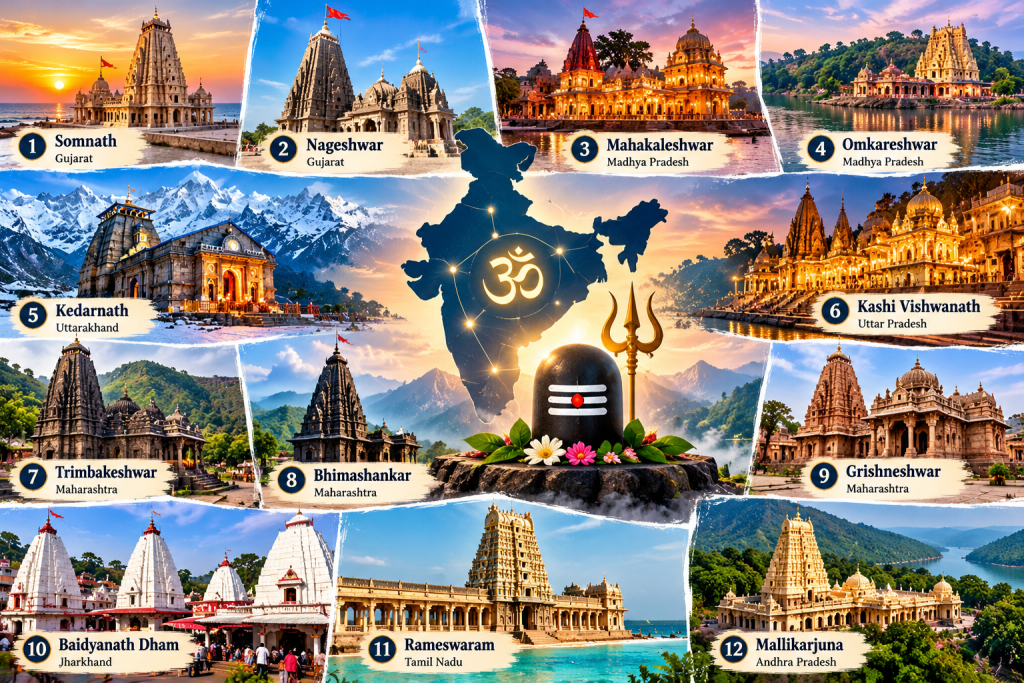
The Jyotirlinga circuit connects twelve sacred shrines dedicated to Lord Shiva. The word Jyotirlinga is commonly understood as a manifestation of Shiva as a divine column of light. These temples are among the most important pilgrimage destinations for devotees of Shaivism.
The twelve traditionally recognised Jyotirlingas are spread across several Indian states.
The twelve Jyotirlinga temples
- Somnath, Gujarat: A celebrated coastal temple associated with the history and worship of Lord Shiva.
- Nageshwar, Gujarat: A major Shiva shrine near Dwarka.
- Mahakaleshwar, Madhya Pradesh: Located in Ujjain, famous for its Bhasma Aarti.
- Omkareshwar, Madhya Pradesh: Situated on an island in the Narmada River, whose shape is traditionally associated with the sacred symbol Om.
- Kedarnath, Uttarakhand: A high-altitude Himalayan shrine and an important part of the Chota Char Dham.
- Kashi Vishwanath, Uttar Pradesh: Located in Varanasi, one of the most significant centres of Shiva worship.
- Trimbakeshwar, Maharashtra: Situated near Nashik and associated with the origin region of the Godavari River.
- Bhimashankar, Maharashtra: A revered shrine surrounded by the Sahyadri hills.
- Grishneshwar, Maharashtra: Located near the Ellora heritage area.
- Baidyanath Dham, Jharkhand: Also known as Baba Baidyanath, an important destination for Shiva devotees.
- Rameswaram, Tamil Nadu: A sacred coastal temple connected with the Ramayana tradition.
- Mallikarjuna, Andhra Pradesh: Located at Srisailam and associated with both Shiva and Goddess Bhramaramba.
How to plan the Jyotirlinga Yatra
Visiting all twelve temples requires considerable time and planning. The shrines are located in different regions, so travellers often divide the journey into smaller geographical circuits.
For example:
- Gujarat circuit: Somnath and Nageshwar.
- Madhya Pradesh circuit: Mahakaleshwar and Omkareshwar.
- Maharashtra circuit: Trimbakeshwar, Bhimashankar, and Grishneshwar.
- Southern circuit: Mallikarjuna and Rameswaram.
- Northern and eastern destinations: Kedarnath, Kashi Vishwanath, and Baidyanath Dham.
Best time to visit: October to March is generally comfortable for many of the lower-altitude destinations. Kedarnath follows a seasonal opening schedule.
Ideal duration: Several weeks for all twelve temples; shorter regional trips can be completed in approximately 4–9 days.
Best for: Shiva devotees, religious history enthusiasts, and travellers interested in India’s temple traditions.
4. Shakti Peetha Circuit: Following the Sacred Geography of Goddess Shakti
The Shakti Peetha tradition is associated with Goddess Sati and the divine feminine power known as Shakti. According to Hindu mythology, after Sati’s death, Lord Shiva carried her body, and Vishnu’s Sudarshan Chakra divided it into parts. The places associated with the falling of these parts became sacred centres of Shakti worship.
The number and identification of Shakti Peethas vary across religious texts and regional traditions. Some of India’s best-known destinations associated with Goddess worship include:
Kamakhya Temple, Assam: Located on Nilachal Hill in Guwahati, Kamakhya is one of the most important centres of Shakti worship. The Ambubachi Mela attracts devotees from across India.
Vaishno Devi, Jammu: Situated in the Trikuta Mountains near Katra, this famous pilgrimage involves a mountain journey to the cave shrine. Pilgrims can use available walking and authorised transport options.
Kalighat Temple, West Bengal: Located in Kolkata, Kalighat is one of the most prominent centres of Goddess Kali worship and is traditionally counted among important Shakti Peetha sites.
Jwala Devi Temple, Himachal Pradesh: Famous for its naturally occurring eternal flames, this temple is an important destination for devotees of Goddess Durga.
Meenakshi Amman Temple, Tamil Nadu: Located in Madurai, this magnificent temple is dedicated to Goddess Meenakshi and Lord Sundareswarar. It is one of South India’s most impressive centres of living temple worship.
Suggested travel approach
Rather than attempting to visit every shrine in one trip, travellers can plan regional journeys:
- Northeast India: Kamakhya and nearby religious destinations.
- Jammu region: Vaishno Devi and other local shrines.
- Himachal Pradesh: Jwala Devi and other Devi temples.
- Kolkata: Kalighat and other important temples.
- Tamil Nadu: Madurai and surrounding temple towns.
Best time to visit: This depends on the destination. October to March is generally comfortable for many locations, while festival periods can offer special cultural experiences but also bring large crowds.
Best for: Goddess worship, festival tourism, religious architecture, and cultural exploration.
5. Krishna and Braj Circuit: Exploring the Land of Lord Krishna
The Braj pilgrimage circuit follows the life and legends of Lord Krishna in the Mathura-Vrindavan region of Uttar Pradesh. It is one of India’s most colourful and culturally rich spiritual journeys.
Mathura is traditionally regarded as Krishna’s birthplace, while Vrindavan is associated with his childhood and divine pastimes. The surrounding towns and villages form an interconnected sacred landscape.
Major destinations in the Braj circuit
Mathura: The Shri Krishna Janmabhoomi area is the principal pilgrimage attraction. The city also has ancient temples and ghats along the Yamuna.
Vrindavan: Known for its numerous Krishna temples, including Banke Bihari Temple, ISKCON Temple, and Prem Mandir. The town attracts devotees throughout the year.
Gokul: Associated with Krishna’s childhood after his birth in Mathura.
Nandgaon: Traditionally connected with Nanda Maharaj, Krishna’s foster father.
Barsana: Associated with Radha and famous for its distinctive Lathmar Holi celebrations.
Govardhan: Pilgrims undertake the Govardhan Parikrama, a religious circumambulation route around the sacred hill.
Festivals and experiences
Holi and Janmashtami are particularly important occasions in the Braj region. During these celebrations, temples, streets, and ghats become centres of devotional music, colourful processions, and religious performances.
Visitors can also experience Yamuna-side rituals, traditional sweets, local markets, temple architecture, and the region’s devotional music traditions.
Suggested route: Delhi → Mathura → Vrindavan → Gokul → Nandgaon → Barsana → Govardhan.
Best time to visit: October to March is generally pleasant. Holi and Janmashtami are special periods for festival tourism, although visitors should expect substantial crowds.
Ideal duration: 3–5 days.
6. Ayodhya, Varanasi, and Prayagraj: The Sacred Cities of Uttar Pradesh
Uttar Pradesh contains some of India’s most significant religious destinations. Ayodhya, Varanasi, and Prayagraj form a powerful spiritual route connecting the traditions of Lord Rama, Lord Shiva, and the sacred rivers of Hinduism.
Ayodhya: The birthplace of Lord Rama
Ayodhya is traditionally revered as the birthplace of Lord Rama and is one of Hinduism’s most important pilgrimage cities. The Ram Mandir has become a major attraction for devotees and visitors interested in India’s religious and architectural heritage.
Other important experiences include visiting Hanuman Garhi, exploring the ghats along the Sarayu River, and witnessing the city’s religious celebrations.
Varanasi: The eternal city of Lord Shiva
Varanasi, also known as Kashi or Banaras, is one of the world’s oldest continuously inhabited cities. It is a major centre of Shiva worship, Hindu philosophy, classical music, and traditional learning.
The city’s ghats are central to its identity. Visitors can experience the morning rituals along the Ganga, take a boat ride at sunrise, visit Kashi Vishwanath Temple, and attend the famous Ganga Aarti in the evening.
Prayagraj: The sacred Triveni Sangam
Prayagraj is famous for the Triveni Sangam, traditionally regarded as the meeting point of the Ganga, Yamuna, and the mythical Saraswati rivers.
The city becomes particularly important during the Kumbh and other major religious gatherings, which attract pilgrims from across India and abroad.
Suggested route
Ayodhya → Varanasi → Prayagraj
Best time to visit: October to March is generally comfortable. Festival dates and major bathing events can attract exceptionally large crowds.
Ideal duration: 5–7 days.
Best for: Hindu pilgrimage, river rituals, ancient city experiences, religious festivals, and cultural tourism.
7. Buddhist Pilgrimage Circuit: Following the Footsteps of Gautama Buddha
The Buddhist circuit is among India’s most important international pilgrimage routes. It connects destinations associated with the life and teachings of Gautama Buddha, including his birth, enlightenment, first sermon, and Mahaparinirvana.
Although Lumbini, the birthplace of Buddha, is located in Nepal, it is commonly included in extended Buddhist pilgrimage itineraries that cover India and neighbouring Nepal.
Major destinations of the Buddhist circuit
Lumbini, Nepal: Traditionally recognised as the birthplace of Gautama Buddha. The sacred garden and archaeological remains make it an important destination for Buddhist pilgrims.
Bodh Gaya, Bihar: The place where Buddha attained enlightenment beneath the Bodhi Tree. The Mahabodhi Temple Complex is a UNESCO World Heritage Site and one of the most sacred Buddhist destinations in the world.
Sarnath, Uttar Pradesh: Located near Varanasi, Sarnath is where Buddha is traditionally believed to have delivered his first sermon after enlightenment. The Dhamek Stupa and archaeological remains are major attractions.
Kushinagar, Uttar Pradesh: Associated with Buddha’s Mahaparinirvana. The Mahaparinirvana Temple and surrounding monasteries attract pilgrims from many countries.
Rajgir, Bihar: An important centre in Buddhist history, associated with Buddha’s teachings and visits.
Nalanda, Bihar: Home to the remains of the ancient Nalanda Mahavihara, an internationally renowned centre of learning. Its archaeological site is also a UNESCO World Heritage Site.
Suggested route
Bodh Gaya → Rajgir → Nalanda → Sarnath → Kushinagar → Lumbini.
The route can be extended to include Vaishali, Kesariya, and other sites associated with Buddhist history.
Best time to visit: October to March, when temperatures are generally more comfortable.
Ideal duration: 7–10 days for a selected route; longer journeys are possible for travellers exploring additional sites.
Best for: Buddhist pilgrims, international visitors, meditation enthusiasts, history lovers, and heritage travellers.
8. Jain Pilgrimage Circuits: The Sacred Journey of the Tirthankaras
Jain pilgrimage routes connect sacred sites associated with the Tirthankaras, Jain philosophy, renunciation, and spiritual liberation. These destinations are particularly important for understanding the principles of ahimsa (non-violence), self-discipline, compassion, and simplicity.
India has several significant Jain pilgrimage destinations, many of which are admired for their extraordinary architecture.
Major Jain pilgrimage destinations
Palitana, Gujarat: Located on Shatrunjaya Hill, Palitana is one of the most important Jain pilgrimage destinations. The hill is home to an extensive complex of beautifully constructed temples. The climb itself is an important part of the pilgrimage experience.
Shravanabelagola, Karnataka: Famous for the enormous monolithic statue of Bahubali, also known as Gomateshwara. The site is a major centre of Jain heritage and attracts visitors during the Mahamastakabhisheka festival.
Ranakpur, Rajasthan: The Ranakpur Jain Temple is renowned for its intricately carved marble pillars, detailed ceilings, and remarkable architectural design.
Pawapuri, Bihar: Traditionally associated with the nirvana of Lord Mahavira, Pawapuri is one of the most sacred destinations for Jain devotees.
Mount Abu, Rajasthan: The Dilwara Temples are celebrated for their detailed marble carvings and exquisite craftsmanship.
Understanding Jain pilgrimage traditions
Jain pilgrimage often emphasises simplicity and respect for all living beings. Visitors should pay attention to local temple rules, dress codes, photography restrictions, and regulations concerning leather items or food.
Best time to visit: October to March is generally suitable for most destinations.
Ideal duration: 5–10 days for a regional journey.
Best for: Jain devotees, architecture enthusiasts, heritage tourism, and travellers interested in Indian philosophy.
9. Sikh Pilgrimage Circuit: Discovering the Heritage of Sikhism
Sikh pilgrimage tourism connects important sites associated with the ten Sikh Gurus and the development of Sikh religious traditions. At the centre of this journey is the Golden Temple in Amritsar, one of India’s most visited religious destinations.
Major Sikh pilgrimage destinations
Golden Temple, Amritsar: Also known as Harmandir Sahib, it is the spiritual heart of Sikhism. Its golden architecture, sacred pool, and devotional atmosphere attract visitors from around the world.
One of its most meaningful traditions is langar, the community kitchen that serves free meals to visitors regardless of religion, caste, nationality, or social background. Visitors can also participate in seva, or selfless service.
Anandpur Sahib, Punjab: A historic Sikh town closely associated with Guru Gobind Singh and the founding of the Khalsa in 1699.
Hazur Sahib, Nanded, Maharashtra: One of the five Takhts of Sikhism, this important gurudwara is associated with the final days of Guru Gobind Singh.
Patna Sahib, Bihar: Also known as Takht Sri Harmandir Sahib, it marks the birthplace of Guru Gobind Singh.
Nankana Sahib, Pakistan: Traditionally recognised as the birthplace of Guru Nanak. A visit requires appropriate international travel documents and compliance with the prevailing cross-border arrangements.
Visitor etiquette
Visitors to the Golden Temple should cover their heads, remove footwear, and maintain respectful behaviour within the complex. Modest clothing and attention to the shrine’s instructions are important.
Suggested route: Delhi → Amritsar → Anandpur Sahib → Patna Sahib, with Hazur Sahib included as a separate extension.
Best time to visit: October to March is generally comfortable for the northern destinations. Festival periods such as Gurpurab offer special experiences but may be crowded.
Ideal duration: 6–8 days for selected destinations, depending on transport connections.
10. Sufi and Islamic Pilgrimage Circuits: Exploring India’s Spiritual Heritage
India’s Sufi heritage represents a rich tradition of spiritual devotion, poetry, music, service, and communal harmony. Sufi shrines and dargahs attract visitors from different religious backgrounds, making them important destinations for cultural and spiritual tourism.
Unlike some of India’s more formally defined pilgrimage routes, Sufi travel often follows the lives and teachings of saints and the historical spread of Sufi traditions.
Major Sufi pilgrimage destinations
Ajmer Sharif Dargah, Rajasthan: The shrine of Khwaja Moinuddin Chishti is one of India’s most famous Sufi destinations. Devotees visit to offer prayers and experience the spiritual atmosphere of the dargah.
Nizamuddin Dargah, Delhi: Dedicated to Sufi saint Hazrat Nizamuddin Auliya, this shrine is also associated with qawwali performances and the city’s historic cultural traditions.
Haji Ali Dargah, Mumbai: Situated on an islet off the Mumbai coast, this well-known shrine is dedicated to Pir Haji Ali Shah Bukhari.
Hyderabad’s Sufi heritage: The city has several historic dargahs and religious sites that reflect its diverse cultural history.
Kashmir’s Sufi heritage: Shrines and spiritual centres across Kashmir preserve important traditions of Sufi and Rishi culture.
What makes Sufi pilgrimage special?
Sufi destinations offer a different experience of spiritual travel. Devotional music, poetry, prayer, community gatherings, and historic architecture are often central to the visitor experience.
Travellers should dress modestly, follow the customs of each shrine, and respect restrictions on photography and movement.
Best time to visit: October to March is generally pleasant for many destinations.
Best for: Cultural tourism, Sufi music, religious heritage, architecture, and interfaith exploration.
11. South India Temple Circuit: A Journey Through Dravidian Architecture
South India has one of the world’s richest living temple traditions. Its temples are known for towering gopurams, elaborate sculptures, pillared halls, sacred tanks, and centuries-old rituals.
A South India temple circuit can combine religious experiences with architecture, history, regional cuisine, classical music, and local festivals.
Important temple circuits in South India
Tamil Nadu Temple Trail
Tamil Nadu is home to some of India’s most famous temples. Important destinations include:
- Meenakshi Amman Temple, Madurai.
- Ramanathaswamy Temple, Rameswaram.
- Ekambareswarar Temple, Kanchipuram.
- Brihadeeswarar Temple, Thanjavur.
- Chidambaram Nataraja Temple.
- The historic temples of Kumbakonam.
The Brihadeeswarar Temple, built during the Chola period, is especially important for its architecture and historical significance.
Tirupati Pilgrimage Circuit
The Tirumala Venkateswara Temple in Andhra Pradesh is one of India’s most prominent pilgrimage destinations. Dedicated to Lord Venkateswara, it attracts devotees throughout the year.
Visitors should plan darshan arrangements in advance, particularly during weekends, holidays, and major festivals.
Kerala Temple Route
Kerala offers a distinctive temple experience shaped by its traditional architecture and rituals. Important destinations include Guruvayur Temple, Sabarimala, and Padmanabhaswamy Temple in Thiruvananthapuram.
Sabarimala follows a distinctive pilgrimage tradition, including prescribed observances and seasonal pilgrimage periods. Visitors should check current temple instructions before planning their trip.
Navagraha Yatra
The Navagraha temples around Kumbakonam in Tamil Nadu are associated with the nine celestial bodies in Hindu astrology. Devotees visit these temples as part of a religious journey connected with planetary worship.
Arupadai Veedu
This pilgrimage connects six important temples dedicated to Lord Murugan across Tamil Nadu. It is an important spiritual route for devotees of the deity.
Suggested South India temple itinerary
Chennai → Kanchipuram → Thanjavur → Kumbakonam → Madurai → Rameswaram.
Best time to visit: November to February is generally comfortable for much of Tamil Nadu.
Ideal duration: 7–10 days for a selected temple route.
Best for: Temple architecture, religious history, classical culture, and South Indian cuisine.
12. Other Important Pilgrimage Destinations Worth Including
Beyond the major circuits, India has many other religious destinations that can be included in regional spiritual itineraries.
Shirdi, Maharashtra: The Sai Baba temple is an important pilgrimage destination for devotees from across India.
Sabarimala, Kerala: One of the most significant Ayyappa pilgrimage destinations, known for its seasonal pilgrimage traditions.
Puri, Odisha: In addition to its role in the all-India Char Dham, Puri is a major destination for Jagannath worship and the annual Rath Yatra.
Deoghar, Jharkhand: Baba Baidyanath Dham is a major Shiva pilgrimage destination and an important part of the regional religious landscape.
Srisailam, Andhra Pradesh: A major pilgrimage centre associated with Mallikarjuna Jyotirlinga and the Bhramaramba Devi temple.
Amarkantak, Madhya Pradesh: An important religious destination associated with the origin of the Narmada River and several temples.
These destinations can be combined with nearby heritage sites and natural attractions to create journeys that balance spiritual experiences with cultural exploration.
Practical Guide to Planning a Pilgrimage Tour in India
A successful pilgrimage requires more preparation than an ordinary holiday. Some destinations are located in remote mountain regions, while others attract exceptionally large crowds during festivals and religious events.
Here are the most important considerations before setting out.
1. Choose a circuit according to your time and interests
Start by identifying the purpose of your journey. If you have only a few days, choose a compact regional circuit such as Braj Yatra or a selected Jyotirlinga route. If you have more time, consider the Buddhist circuit or the all-India Char Dham.
Do not try to cover too many distant destinations in a single trip. A well-planned journey allows enough time for darshan, rest, local exploration, and unexpected delays.
2. Check registration and advance booking requirements
Some major pilgrimage destinations require registration, permits, or advance darshan arrangements. Requirements can change according to the season and local administration.
For example, Uttarakhand’s Chota Char Dham Yatra has an official registration and verification system. Pilgrims should use the official portal and check the latest notices before departure.
For popular temples such as Tirupati and Vaishno Devi, consult the official booking or pilgrimage information channels before finalising travel dates.
3. Select the right season
Weather has a major influence on pilgrimage travel. Mountain routes may be affected by snowfall, heavy rain, landslides, or road closures. Coastal and plains destinations can become uncomfortable during extreme summer conditions.
As a general guide:
- Himalayan pilgrimage: Check the official seasonal opening dates and weather advisories.
- North Indian temple circuits: October to March is often comfortable.
- South Indian temple circuits: November to February is generally pleasant in many areas.
- Buddhist circuit: October to March is a popular period.
- Festival travel: Book accommodation and transport early, as demand increases significantly.
These are broad planning windows, not guarantees of suitable conditions. Always check local weather and temple schedules.
4. Prepare for physical challenges
Some pilgrimage routes involve steep climbs, long walking distances, high altitudes, and limited facilities. Travellers undertaking mountain journeys should assess their fitness and consult a healthcare professional if they have concerns about travelling at altitude.
Carry comfortable footwear, prescribed medicines, water, warm clothing, rain protection, and essential identification documents.
5. Respect religious customs
Every religious destination has its own traditions and rules. Visitors should dress appropriately, remove footwear where required, cover their heads at designated shrines, and follow instructions regarding photography.
Avoid loud conversations during prayers and rituals. Ask permission before photographing people or religious ceremonies.
6. Choose accommodation and transport carefully
Accommodation ranges from hotels and guesthouses to dharamshalas, religious rest houses, and homestays. During festivals and peak pilgrimage seasons, availability can become limited.
Where possible, book accommodation close to the main pilgrimage area or along the planned route. For remote destinations, use authorised transport operators and verify the availability of local services.
7. Support local communities
Responsible pilgrimage tourism can create meaningful benefits for local communities. Consider staying in locally operated accommodation, hiring local guides, purchasing handicrafts directly from artisans, and eating at local establishments.
Keep religious sites clean, avoid single-use plastic where possible, and respect the natural environment surrounding sacred destinations.
Suggested Pilgrimage Tourism Itineraries in India
The following itineraries provide starting points for travellers. Actual travel time will depend on transport availability, road conditions, temple schedules, and the time of year.
| Circuit | Suggested route | Approximate duration |
|---|---|---|
| Chota Char Dham | Haridwar → Yamunotri → Gangotri → Kedarnath → Badrinath | 10–14 days |
| Buddhist Circuit | Bodh Gaya → Rajgir → Nalanda → Sarnath → Kushinagar → Lumbini | 7–10 days |
| Jyotirlinga sampler | Somnath → Dwarka → Mahakaleshwar → Omkareshwar | 7–9 days |
| Braj Yatra | Delhi → Mathura → Vrindavan → Gokul → Barsana → Govardhan | 3–5 days |
| South India Temple Trail | Chennai → Kanchipuram → Thanjavur → Madurai → Rameswaram | 7–10 days |
| Sikh Heritage Trail | Delhi → Amritsar → Anandpur Sahib → Patna Sahib | 6–8 days |
| Uttar Pradesh Sacred Cities | Ayodhya → Varanasi → Prayagraj | 5–7 days |
Important: The Buddhist itinerary includes Lumbini in Nepal, so international border-crossing requirements must be considered. The Sikh heritage route includes destinations in different parts of India; travel connections should be checked before booking.
Frequently Asked Questions About Pilgrimage Tourism in India
1. Which is the most famous pilgrimage circuit in India?
The Char Dham Yatra and Chota Char Dham Yatra are among India’s best-known Hindu pilgrimage circuits. Other major routes include the Jyotirlinga circuit, Buddhist circuit, and Sikh pilgrimage circuit.
2. What is the difference between Char Dham and Chota Char Dham?
The traditional all-India Char Dham connects Badrinath, Dwarka, Puri, and Rameswaram. The Chota Char Dham is located in Uttarakhand and includes Yamunotri, Gangotri, Kedarnath, and Badrinath.
3. How many Jyotirlingas are there in India?
There are twelve traditionally recognised Jyotirlingas dedicated to Lord Shiva. They are located across several Indian states.
4. Which is the most important Buddhist pilgrimage destination in India?
Bodh Gaya in Bihar is one of the most important Buddhist pilgrimage destinations because it is traditionally recognised as the place where Gautama Buddha attained enlightenment. Its Mahabodhi Temple Complex is a UNESCO World Heritage Site.
5. What is the best time for pilgrimage tourism in India?
October to March is generally suitable for many pilgrimage destinations in the plains and southern regions. Himalayan shrines follow seasonal opening schedules, so travellers should check official dates and weather advisories.
6. Are pilgrimage tours suitable for senior citizens?
Many pilgrimage destinations are accessible to senior citizens, but some routes involve long walks, steep climbs, or high-altitude conditions. Travellers should select destinations according to their health, mobility, and comfort, and check available transport and assistance facilities.
7. Can international tourists visit India’s pilgrimage destinations?
Yes. Many religious destinations welcome international visitors. However, travellers should check visa requirements, local entry rules, dress codes, and any special arrangements applicable to particular sites.
8. How can I plan a budget pilgrimage tour?
Choose destinations within the same region, travel during less crowded periods, compare train and bus options, and consider guesthouses or dharamshalas where available. Booking transport and accommodation early can also help manage expenses.
Final Thoughts: Discover India’s Spiritual Heritage Through Pilgrimage Tourism
India’s pilgrimage circuits offer a remarkable way to explore the country’s spiritual, cultural, and historical identity. From the Himalayan temples of Kedarnath and Badrinath to the sacred ghats of Varanasi, from the Buddhist heritage of Bodh Gaya to the peaceful atmosphere of the Golden Temple, every journey reveals a different dimension of India’s religious diversity.
The Char Dham connects sacred destinations across the country’s four directions. The Jyotirlinga circuit follows the traditions of Lord Shiva, while the Braj circuit celebrates the life and legends of Lord Krishna. The Buddhist, Jain, Sikh, and Sufi routes reveal the country’s many spiritual traditions and their enduring influence on society.
For travellers, these journeys offer more than a checklist of famous religious sites. They provide opportunities to understand local communities, experience traditional festivals, admire extraordinary architecture, and discover the landscapes that have shaped India’s sacred geography.
Whether you are planning a short temple visit or a multi-week pilgrimage, thoughtful preparation and respect for local customs can make the experience more rewarding. Travel slowly, plan responsibly, and allow every destination to tell its own story.
References and Further Reading
The following official and institutional sources can help readers verify destination information, understand pilgrimage traditions, and plan their journeys.
- Uttarakhand Tourism – Char Dham Yatra: Official information about Yamunotri, Gangotri, Kedarnath, and Badrinath.
https://uttarakhandtourism.gov.in/experiences/char-dham - Tourist Care Uttarakhand – Official Yatra Registration Portal: Registration, verification, travel updates, and pilgrimage guidance.
https://registrationandtouristcare.uk.gov.in/ - Ministry of Tourism, Government of India – Religious Tourist Circuits: Government information on thematic tourism circuits, including Spiritual, Ramayana, Krishna, Buddhist, Tirthankar, and Sufi circuits.
https://tourism.gov.in/ - Press Information Bureau – Development of Buddhist Tourism: Government information on Buddhist tourism circuits and destinations.
https://www.pib.gov.in/newsite/PrintRelease.aspx?lang=2®=48&relid=103310 - UNESCO World Heritage Centre – Mahabodhi Temple Complex at Bodh Gaya:
https://whc.unesco.org/en/list/1056/ - UNESCO World Heritage Centre – Archaeological Site of Nalanda Mahavihara:
https://whc.unesco.org/en/list/1502/ - Bihar Tourism – Official Tourism Circuits: Information about Jain, Sikh, Ramayan, and other tourism circuits in Bihar.
https://tourism.bihar.gov.in/en/circuits - District Amritsar, Government of Punjab – Places of Interest: Visitor information about the Golden Temple and its traditions.
https://amritsar.nic.in/places-of-interest/ - Government of India – National Government Services Portal: Char Dham and Hemkund Sahib registration services.
https://services.india.gov.in/