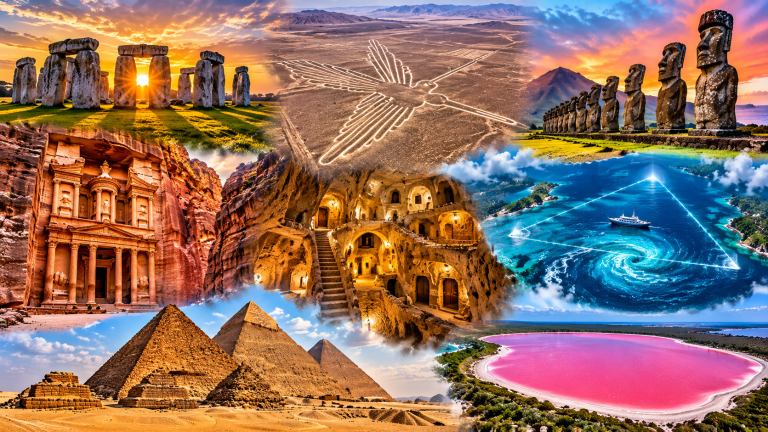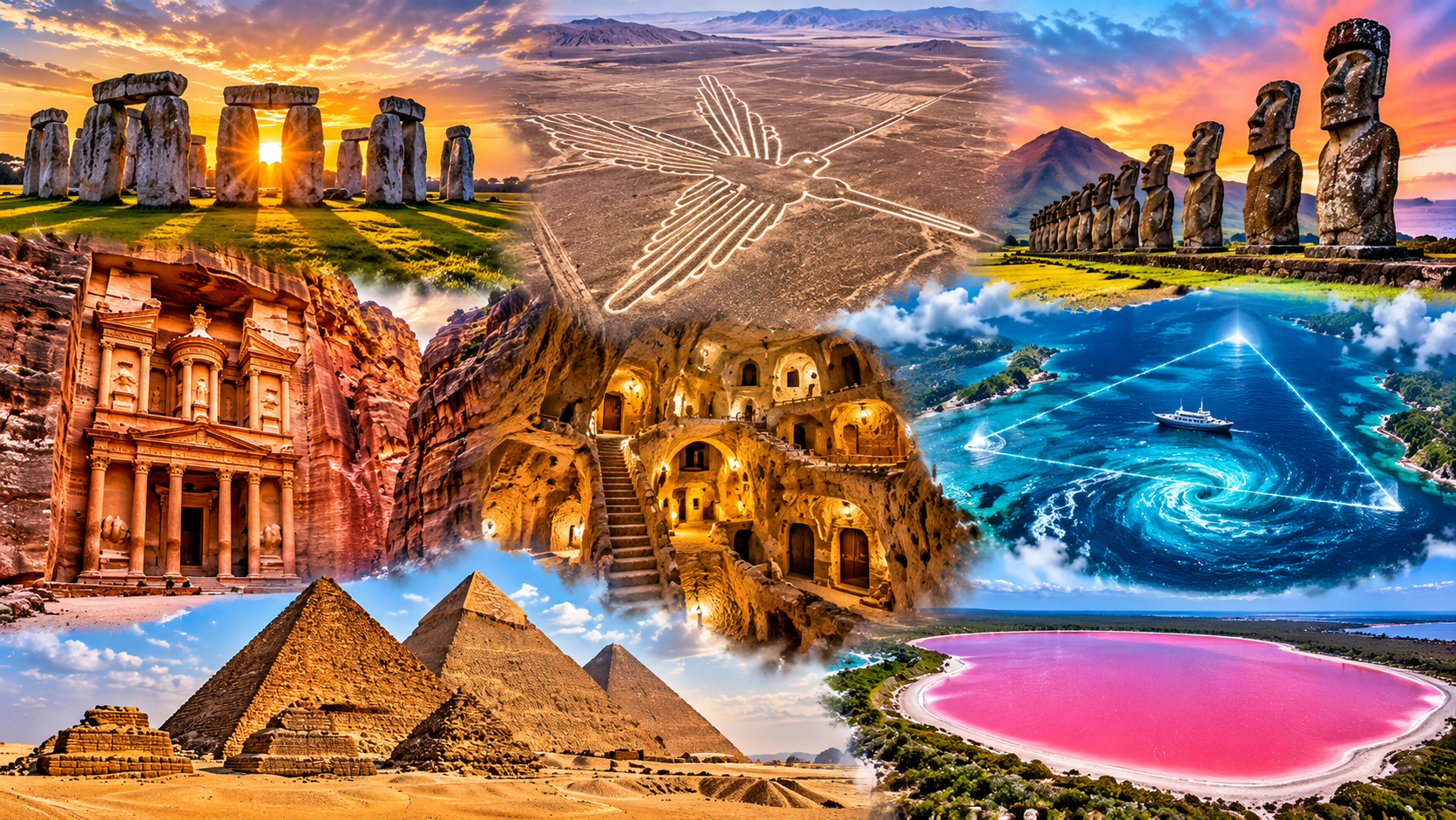
Imagine standing before an enormous prehistoric stone circle, exploring passages beneath an ancient settlement or seeing gigantic animal drawings stretched across a desert. The most mysterious tourist places in the world offer more than extraordinary views: they invite questions about how people lived, what they believed and how they transformed their surroundings.
Some destinations preserve genuine archaeological puzzles. Others owe their reputation to folklore, sensational storytelling or natural processes that science can explain. The key to appreciating them is curiosity—combined with a willingness to distinguish evidence from legend.
From Stonehenge in England to the underground cities of Cappadocia, these eight destinations reveal why the stories behind a place can be as compelling as the journey itself.
1. Stonehenge, England: A Prehistoric Circle with a Celestial Connection
Standing on Salisbury Plain in Wiltshire, Stonehenge is one of the world’s most remarkable prehistoric monuments. Its carefully shaped stones and enormous horizontal lintels demonstrate sophisticated engineering. UNESCO describes it as the most architecturally sophisticated prehistoric stone circle in the world.
What makes Stonehenge mysterious?
The central question is not simply how its builders moved the stones, but what the monument meant to them.
Archaeological evidence establishes connections with burial and ceremony. Stonehenge served as a cremation cemetery, while its stone circle and Avenue align with the midsummer sunrise and midwinter sunset. These relationships indicate that seasonal events mattered to its builders, although the precise ceremonies and beliefs remain uncertain.
Legends involving supernatural builders may be entertaining, but the physical evidence points to organised prehistoric communities with impressive technical capabilities.
Why visit?
Stonehenge becomes more meaningful when explored as part of a wider landscape of burial mounds, settlements and ceremonial monuments—not as an isolated circle. Nearby Avebury offers another extraordinary perspective on prehistoric monument building.
Planning note: Check official admission arrangements and distinguish standard visits from any separately managed access opportunities.
2. Nazca Lines, Peru: Enormous Drawings Across the Desert
In southern Peru, vast designs spread across an arid coastal plain. Known as geoglyphs, the Nazca Lines include living creatures, stylised plants and geometric figures, some extending for kilometres. UNESCO dates their creation broadly between 500 BC and AD 500.
What is the mystery behind the Nazca Lines?
Their scale raises an irresistible question: why create enormous images across a desert?
Researchers have considered religious ceremonies, sacred movement through the landscape and relationships with environmental resources. UNESCO places the geoglyphs within the religious and cultural world of ancient societies on Peru’s southern coast. Their meaning is therefore best investigated through those societies, rather than through stories about extraterrestrial visitors.
The drawings are evidence of human creativity and organised activity. The remaining questions concern their varied functions, chronology and significance—not whether humans were capable of making them.
Why visit?
The combination of ancient art and open desert makes Nazca an unusual archaeological destination. Many large designs are most readily appreciated from above, although ground-based viewpoints offer another perspective.
Planning note: Compare viewing options carefully. For scenic flights, check current operator authorisations, conditions and cancellation arrangements before booking.
3. Easter Island, Chile: The Story Behind the Moai
Easter Island, known locally as Rapa Nui, is famous for its monumental stone figures called moai. UNESCO documentation estimates approximately 900 statues and more than 300 ceremonial platforms, reflecting the scale of the island’s archaeological heritage.
What makes the moai mysterious?
The statues inspire questions about carving, transport and the coordination needed to position such large monuments.
The supplied account describes experimental research suggesting that some moai could have been moved upright with ropes and coordinated rocking movements—the basis for the memorable idea that the statues “walked.” Such experiments demonstrate plausible methods, rather than proving that every statue travelled in precisely the same way.
The moai also belong to Rapa Nui ancestral and ceremonial traditions. Treating them only as an engineering puzzle overlooks the culture that created them.
Why visit?
Rapa Nui combines monumental archaeology with volcanic and coastal landscapes. Its statues are not anonymous remnants of a vanished fantasy civilisation; they are part of a distinctive Polynesian cultural heritage.
Planning note: Treat ceremonial platforms and statues as protected cultural places. Check current park entry and guiding requirements before arranging visits.
4. Petra, Jordan: The Rose City and Its Hidden Engineering
Petra’s sandstone façades are spectacular, but its importance extends beyond their appearance. This Nabataean caravan city connected trade between Arabia, Egypt and Syria-Phoenicia, with goods arriving from much farther afield. Its architecture blends local traditions with Hellenistic influences.
What is the mystery behind Petra?
The most revealing question is how a substantial city flourished in an arid setting.
The answer lies partly in water engineering. Channels, tunnels, diversion dams, cisterns and reservoirs collected, controlled and conserved seasonal rainfall. UNESCO identifies this system as fundamental to Petra’s extensive settlement.
Al-Khazneh, commonly called the Treasury, adds another layer of storytelling. Its popular name suggests hidden riches, but UNESCO places it within Petra’s monumental rock-cut tomb architecture. The legend should not replace the archaeological interpretation.
Why visit?
The approach through the Siq, the Treasury façade, tombs and wider city remains reveal how architecture, trade and water management worked together. Petra rewards visitors who look beyond its best-known photograph.
Planning note: Allow time for walking, follow local weather guidance and avoid entering closed routes. UNESCO identifies flash flooding as a genuine management concern.
5. Cappadocia, Türkiye: Underground Cities Beneath Fairy Chimneys
Cappadocia’s landscape combines valleys, pinnacles and rock-cut buildings. Its famous “fairy chimneys” formed through erosion within a volcanic landscape, while generations of inhabitants carved dwellings, churches and underground spaces into the rock.
Why were Cappadocia’s underground cities built?
Kaymaklı and Derinkuyu are among the region’s best-known subterranean settlements. UNESCO explains that underground towns served as places of refuge during periods of invasion, including Arab incursions.
Their fascination lies in the practical challenge of organising protected communal spaces below ground. The history is more nuanced than sensational claims of vast populations living permanently underground: different complexes developed and functioned in different ways.
The engineering becomes more impressive—not less—when understood as a response to real conditions and security needs.
Why visit?
Cappadocia offers an unusual opportunity to connect geology with cultural history. Above ground, erosion shaped the landscape; within it, people created homes, sanctuaries and refuges. UNESCO also highlights the importance of its Byzantine rock-hewn churches and their decoration.
Planning note: Before entering an underground complex, check its current visitor route and consider whether enclosed spaces suit your comfort and mobility.
6. Bermuda Triangle: A Maritime Legend Examined
The Bermuda Triangle is generally described as a region of the western North Atlantic associated with stories of missing ships and aircraft. However, it has no officially delineated boundaries, and the US Board on Geographic Names does not recognise it as an official geographic name.
Is the Bermuda Triangle really unexplained?
Its reputation is far more dramatic than the evidence.
According to the US National Oceanic and Atmospheric Administration, there is no evidence that mysterious disappearances occur more frequently here than in other large, heavily travelled ocean regions. Storms, Gulf Stream conditions, navigational hazards and human error provide practical explanations for many incidents.
NOAA also notes that the US Navy and Coast Guard do not accept supernatural explanations for maritime disasters. Claims about portals or Atlantis belong to popular storytelling, not established science.
Why visit?
The appeal lies in maritime history and the destinations associated with the legend, rather than an identifiable attraction called “the Triangle.”
Planning note: Evaluate boat trips using ordinary marine-safety considerations and current weather information, not the region’s sensational reputation.
7. Great Pyramid of Giza, Egypt: An Ancient Engineering Achievement
The Great Pyramid of Khufu forms part of the Memphis and its Necropolis World Heritage property, which includes the pyramid fields from Giza to Dahshur. UNESCO identifies it as the only surviving wonder of the ancient world.
What remains mysterious about the Great Pyramid?
The enduring fascination concerns the organisation and engineering behind its construction: moving material, coordinating labour and creating a monument of extraordinary precision.
The supplied account correctly distinguishes between unresolved details of construction and unsupported claims about alien builders. Questions about particular techniques do not erase the monument’s Egyptian historical context.
The most interesting story is the capacity of ancient society to coordinate skilled work on such a scale—not an assumption that ancient people required supernatural assistance.
Why visit?
The wider Giza landscape places the Great Pyramid alongside other pyramids, tombs and the Great Sphinx. Experiencing the ensemble helps explain its setting within a monumental funerary tradition.
Planning note: Check which monuments and internal areas your ticket covers; do not assume that general site entry includes every chamber.
8. Lake Hillier, Australia: A Famous Pink Lake with a Changing Appearance
Lake Hillier lies on Middle Island in Western Australia’s Recherche Archipelago. It became internationally recognisable through photographs showing pink water beside vegetation and blue ocean. However, current regional tourism information warns that it is no longer the vivid pink seen in many older images and that its colour cannot be guaranteed.
Why is Lake Hillier associated with pink water?
The supplied account links the colour to biological activity in its highly saline environment. This is a natural phenomenon, not evidence of artificial colouring or supernatural forces.
For travellers, the essential distinction is between the lake’s photographic reputation and its current appearance. A booking should not be based on an assumption that historic promotional images reflect present conditions.
Why visit?
The attraction combines a remote island setting with an unusual natural history. Access is logistically challenging, so current visitor information matters as much as the destination’s reputation.
Planning note: Confirm access arrangements, tour availability and recent colour reports before paying for a trip.
Tips for Visiting Mysterious Tourist Places Responsibly
These destinations are best approached as places to understand, not puzzles to sensationalise.
- Check official access rules, booking requirements and local travel advice.
- Use qualified guides who distinguish evidence, interpretation and folklore.
- Avoid touching fragile surfaces or entering restricted areas.
- Respect living communities and the cultural meaning of monuments.
- Verify current conditions rather than relying on old photographs.
- Choose specialist excursions, including flights and marine trips, with safety in mind.
Conservation is part of the experience: UNESCO identifies tourism pressure among the challenges affecting both Petra and Cappadocia.
Frequently Asked Questions
What is the most mysterious tourist place in the world?
There is no objective winner. Stonehenge, Nazca and Rapa Nui offer different kinds of archaeological questions, while the Bermuda Triangle illustrates how a powerful legend can exceed the supporting evidence.
Where are the giant desert drawings?
The Nazca Lines are in southern Peru. Their designs include creatures, plants and extensive geometric figures.
Is the Bermuda Triangle unusually dangerous?
NOAA finds no evidence of a higher frequency of mysterious disappearances than in comparable heavily travelled ocean regions. Normal maritime and aviation risks still apply.
Is Lake Hillier always pink?
No. Regional tourism information explicitly warns that its pink colour cannot be guaranteed and that its appearance has changed.
Conclusion
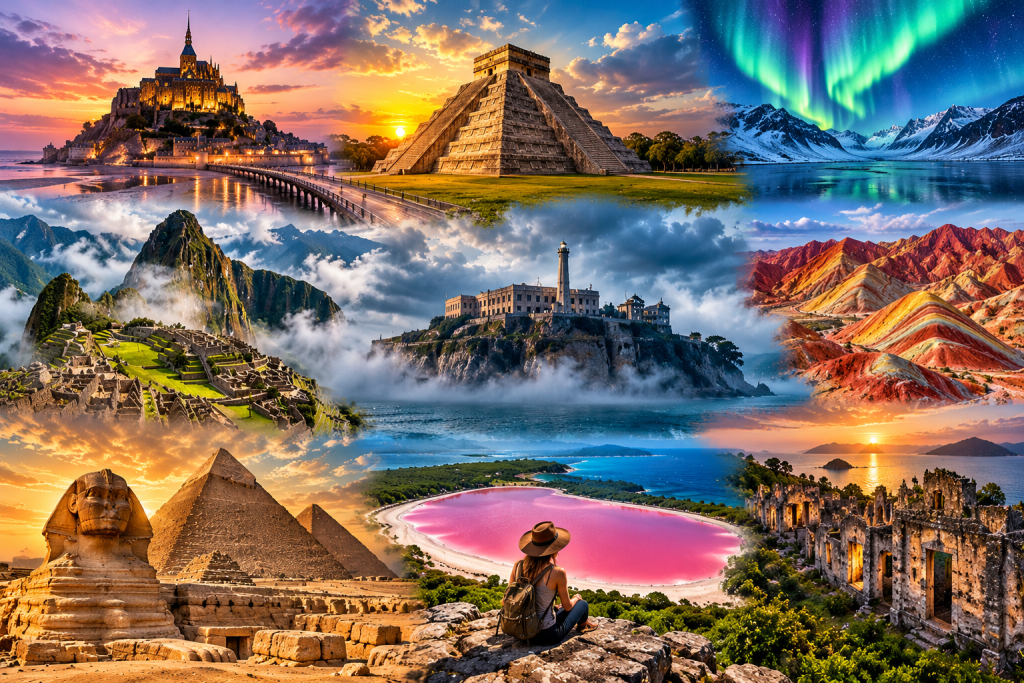
The world’s most mysterious tourist places are compelling because they connect spectacular settings with meaningful questions. Some preserve uncertainties about ancient beliefs or construction methods. Others show how folklore can overshadow a scientific explanation.
Visiting with an informed perspective does not diminish the wonder. It shifts attention toward something more rewarding: the ingenuity of past communities, the complexity of cultural traditions and the extraordinary processes shaping the natural world.
Sources and Further Reading
- UNESCO World Heritage Centre — Stonehenge, Avebury and Associated Sites: engineering, ceremonial use and solar alignments.
- UNESCO World Heritage Centre — Lines and Geoglyphs of Nasca and Palpa: chronology and cultural significance.
- UNESCO World Heritage Centre — Rapa Nui periodic reporting: statues and ceremonial platforms.
- UNESCO World Heritage Centre — Petra: architecture, trade and water management.
- UNESCO World Heritage Centre — Göreme National Park and the Rock Sites of Cappadocia: geology, underground settlements and refuge functions.
- NOAA National Ocean Service — “What is the Bermuda Triangle?”
- UNESCO World Heritage Centre — Memphis and its Necropolis: the pyramid fields from Giza to Dahshur.
- Australia’s Golden Outback — Lake Hillier: location and current colour caveat.