Have you ever seen a travel photograph and wondered whether the place could really exist? From mirror-like salt flats and glowing caves to pink lakes, floating mountains, and rainbow-coloured hills, the world is full of landscapes that seem too extraordinary to be real.
These most unreal places in the world offer more than beautiful views. They provide unforgettable travel experiences shaped by geology, weather, wildlife, culture, and light. Whether you want to walk across a giant natural mirror, fly above fairy chimneys, or explore an underground starry sky, these destinations belong on every travel bucket list.
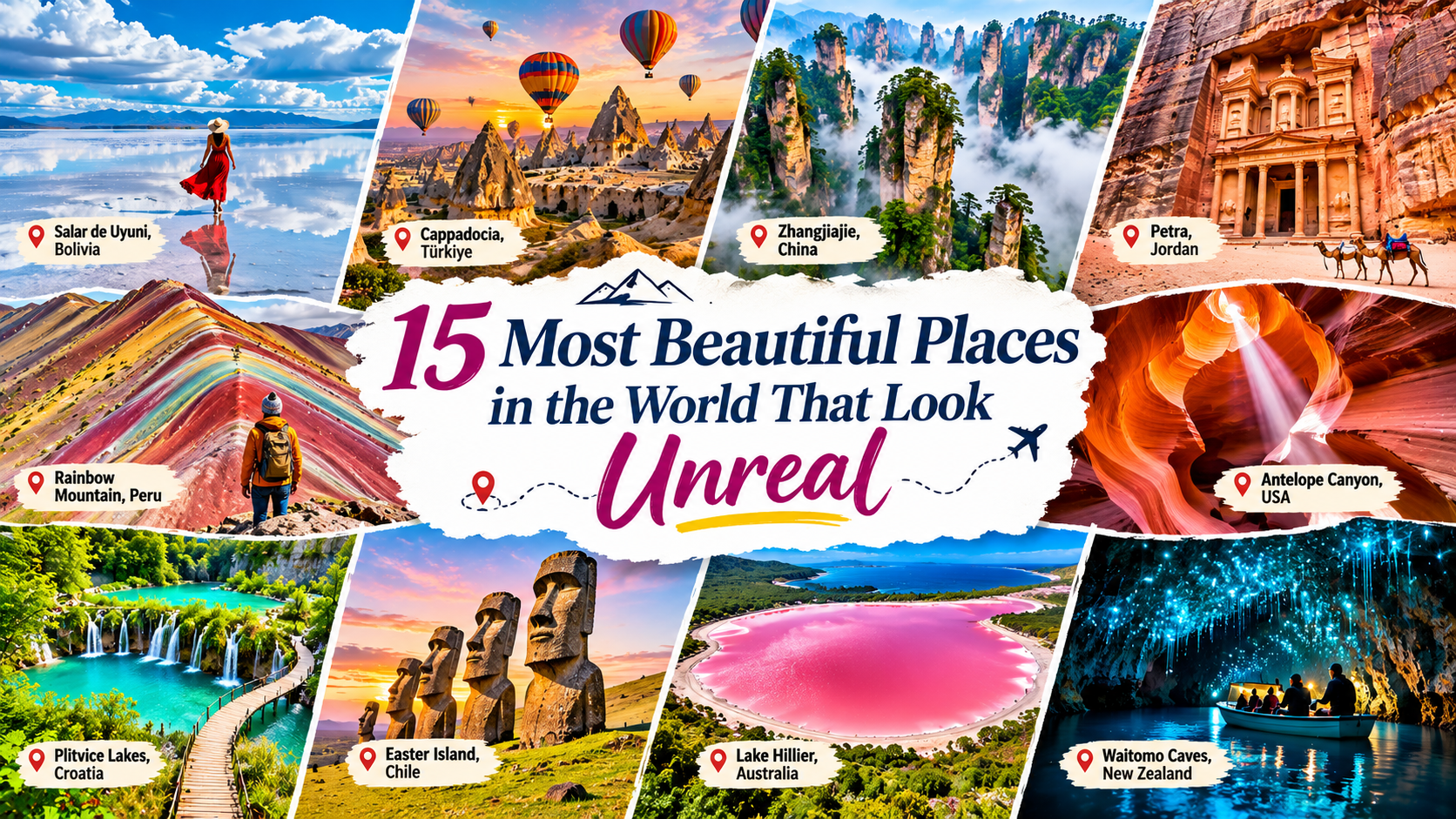
Here are 15 of the most beautiful and surreal places on Earth that look almost impossible to believe.
1. Salar de Uyuni, Bolivia: The World’s Largest Natural Mirror
Salar de Uyuni in southwestern Bolivia is the world’s largest salt flat and one of the most surreal landscapes on Earth. During the rainy season, a thin layer of water turns parts of the salt flat into a giant natural mirror, reflecting the sky, clouds, and distant mountains.
Even in the dry season, the endless white salt crust creates a striking geometric landscape that feels completely otherworldly.
Best time to visit: January to March for the mirror effect; May to November for dry salt-flat scenery.
Travel experience: Take a guided 4×4 tour, photograph the reflections, and visit nearby colourful lagoons.
2. Zhangjiajie National Forest Park, China: Floating Mountains in the Clouds
Zhangjiajie National Forest Park in China’s Hunan Province is famous for its towering sandstone pillars rising from forested valleys. On misty mornings, the peaks appear to float above the clouds.
The park’s dramatic scenery is often associated with the inspiration behind the floating mountains in Avatar, making it one of the most recognizable otherworldly destinations in Asia.
Best time to visit: April to June and September to November.
Travel experience: Ride the scenic cable cars, walk elevated pathways, and visit panoramic mountain viewpoints.
3. Cappadocia, Türkiye: A Fairy-Tale Landscape at Sunrise
Cappadocia is one of the world’s most magical sunrise destinations. Its fairy chimneys, cave dwellings, underground cities, and unusual valleys were shaped by volcanic activity and centuries of erosion.
At sunrise, hundreds of hot-air balloons rise above the rocky landscape, creating one of the most iconic travel scenes in the world.
Best time to visit: April to June and September to October.
Travel experience: Take a hot-air balloon flight, stay in a cave hotel, and explore Göreme’s valleys.
4. Plitvice Lakes National Park, Croatia: Turquoise Lakes and Waterfalls
Plitvice Lakes National Park is one of Europe’s most beautiful natural wonders. Its chain of lakes is connected by waterfalls and travertine barriers, with water shifting between turquoise, emerald, and deep blue.
Wooden walkways allow visitors to explore the park while passing close to cascading waterfalls and calm forest lakes.
Best time to visit: May, June, and September.
Travel experience: Follow marked trails, visit panoramic viewpoints, and photograph the waterfalls.
5. Pamukkale, Türkiye: White Terraces That Look Like Snow
Pamukkale, meaning “Cotton Castle” in Turkish, is famous for its brilliant white travertine terraces. Mineral-rich thermal waters have created cascading pools that resemble a snowy landscape in a warm region of Türkiye.
Nearby Hierapolis adds ancient history to the natural wonder, making Pamukkale a rare combination of geology and heritage.
Best time to visit: April to June and September to October.
Travel experience: Walk barefoot through designated travertine areas and explore the ancient city of Hierapolis.
6. Socotra Island, Yemen: The Most Alien-Looking Place on Earth
Socotra Island is one of the most unusual destinations in the world. Located in the Indian Ocean, it is known for rare plant species, dramatic limestone landscapes, secluded beaches, and remarkable biodiversity.
Its dragon blood trees, with their umbrella-shaped canopies, make the island look like a scene from a science-fiction film.
Best time to visit: October to April.
Travel experience: Explore dragon blood tree forests, remote beaches, caves, and protected natural areas with responsible local guides.
7. Wadi Rum, Jordan: The Valley of the Moon
Wadi Rum in southern Jordan is one of the most dramatic desert landscapes in the Middle East. Its red sand, sandstone mountains, natural arches, and narrow canyons have made it a popular filming location for science-fiction and adventure movies.
The desert changes colour throughout the day, from golden tones in the morning to deep red at sunset.
Best time to visit: March to May and September to November.
Travel experience: Take a jeep safari, hike to viewpoints, and spend a night in a Bedouin desert camp.
8. Antelope Canyon, USA: A Sculpted World of Light and Stone
Antelope Canyon in Arizona is famous for its narrow passageways and smooth, wave-like sandstone walls. Sunlight entering through openings above creates glowing shades of orange, red, and gold.
The canyon is one of the best destinations in the United States for landscape photography, but access is controlled through authorised guided tours.
Best time to visit: March to October, depending on the canyon section and tour.
Travel experience: Join an authorised Navajo-guided tour and photograph the sculpted sandstone formations.
9. The Great Blue Hole, Belize: A Perfect Circle in the Ocean
The Great Blue Hole near Lighthouse Reef in Belize is a giant circular marine sinkhole surrounded by turquoise water and coral reefs. From the air, its dark blue centre creates an extraordinary contrast with the shallow reef around it.
It is especially popular with divers, aerial photographers, and travellers interested in marine landscapes.
Best time to visit: December to May.
Travel experience: Take a scenic flight, join a qualified diving expedition, or explore nearby reefs through responsible marine tours.
10. Lake Hillier, Australia: The Mysterious Pink Lake
Lake Hillier, on Middle Island in Western Australia, is famous for its striking bubble-gum-pink colour. The lake’s unusual appearance contrasts sharply with the surrounding green vegetation and blue ocean.
Its colour is linked to salt-loving microorganisms and environmental conditions. Because access is restricted, scenic flights are the most practical way to see it.
Best time to visit: Warmer months, although access is limited.
Travel experience: Book an authorised scenic flight and follow local environmental restrictions.
11. The Faroe Islands: Green Cliffs Above the Atlantic
The Faroe Islands, located between Iceland and Norway, offer some of Europe’s most dramatic coastal scenery. Green mountains rise directly from the Atlantic Ocean, while remote villages sit between steep cliffs and deep valleys.
The waterfall at Gásadalur, plunging toward the sea from a cliffside, is one of the islands’ most iconic sights.
Best time to visit: May to September.
Travel experience: Hike coastal trails, explore villages, and photograph waterfalls and ocean cliffs.
12. Rainbow Mountain, Peru: Nature’s Colourful Masterpiece
Rainbow Mountain, also known as Vinicunca, is one of Peru’s most visually striking natural attractions. Its slopes display bands of red, yellow, green, purple, and other mineral colours.
The colours come from geological layers and mineral deposits exposed by erosion. Because the trek is at high altitude, visitors should allow time to acclimatise in Cusco before visiting.
Best time to visit: May to September.
Travel experience: Join a guided high-altitude trek and enjoy views of the surrounding Andes.
13. Iguazu Falls, Argentina and Brazil: A Waterfall Beyond Imagination
Iguazu Falls, on the border between Argentina and Brazil, is one of the world’s most powerful waterfall systems. Hundreds of cascades stretch across a vast river landscape surrounded by tropical rainforest.
The Devil’s Throat is the most dramatic section, where an immense volume of water plunges into a deep gorge.
Best time to visit: March to May and August to October.
Travel experience: Explore trails and viewpoints on both the Argentine and Brazilian sides.
14. The Lofoten Islands, Norway: Arctic Mountains and Midnight Sun
The Lofoten Islands in Norway are among the most breathtaking destinations in northern Europe. Sharp mountain peaks rise directly from the sea, while colourful fishing villages sit beside beaches and fjords.
In summer, the midnight sun creates long golden evenings. In winter, the islands become a popular destination for Northern Lights viewing.
Best time to visit: June to August for hiking and midnight sun; September to March for the Northern Lights.
Travel experience: Take a coastal road trip, explore fishing villages, and photograph Arctic landscapes.
15. Waitomo Glowworm Caves, New Zealand: A Starry Sky Underground
The Waitomo Glowworm Caves in New Zealand offer one of the world’s most magical underground experiences. Thousands of bioluminescent glowworms light the cave ceiling, creating the effect of a star-filled night sky.
Because the glow comes from living organisms rather than artificial lights, the experience feels especially extraordinary.
Best time to visit: Year-round, subject to tour availability and weather conditions.
Travel experience: Join a guided cave tour and experience the glowworm-lit underground environment.
How to Plan a Trip to Unreal Destinations
Extraordinary landscapes often require more planning than ordinary city breaks. Some destinations are remote, seasonal, high-altitude, or accessible only with guided tours.
- Choose the right season: Mirror effects, waterfalls, mountain colours, and the Northern Lights depend heavily on weather.
- Check permits and access rules: Places such as Antelope Canyon and Waitomo require authorised tours.
- Prepare for altitude: Destinations such as Rainbow Mountain require acclimatisation and physical preparation.
- Book local guides: Guided tours improve safety and support local communities.
- Travel responsibly: Stay on marked paths, avoid disturbing wildlife, and respect local customs.
- Do not rely only on photos: Weather, light, and camera techniques can make a destination look very different in person.
FAQs About the Most Unreal Places in the World
Which is the most unreal-looking place in the world?
Salar de Uyuni in Bolivia is often considered one of the most surreal places on Earth because its flooded salt flats reflect the sky like an enormous natural mirror.
Which destinations look like another planet?
Socotra Island in Yemen, Zhangjiajie National Forest Park in China, and Wadi Rum in Jordan are among the most otherworldly destinations because of their unusual rock formations, rare plants, and desert scenery.
What is the most colourful natural destination?
Rainbow Mountain in Peru, Lake Hillier in Australia, and Pamukkale in Türkiye are among the most colourful natural attractions in the world.
Which unreal destination is best for a honeymoon?
Cappadocia, the Faroe Islands, and the Lofoten Islands are excellent honeymoon destinations thanks to their dramatic scenery, romantic experiences, and memorable photography opportunities.
Which destination is best for nature lovers?
Plitvice Lakes National Park, Socotra Island, and the Faroe Islands are ideal for travellers who love biodiversity, hiking, waterfalls, and dramatic natural landscapes.
Final Thoughts
The world is far more extraordinary than ordinary photographs can capture. From Bolivia’s mirror-like salt flats to New Zealand’s glowing caves, these 15 unreal places prove that nature can create landscapes more dramatic than any fantasy film.
Some destinations amaze through colour, others through scale, and others through unusual geological formations. If you are planning your next international trip, add one of these surreal destinations to your bucket list—because the most unforgettable journeys often take you somewhere that feels almost impossible to believe.