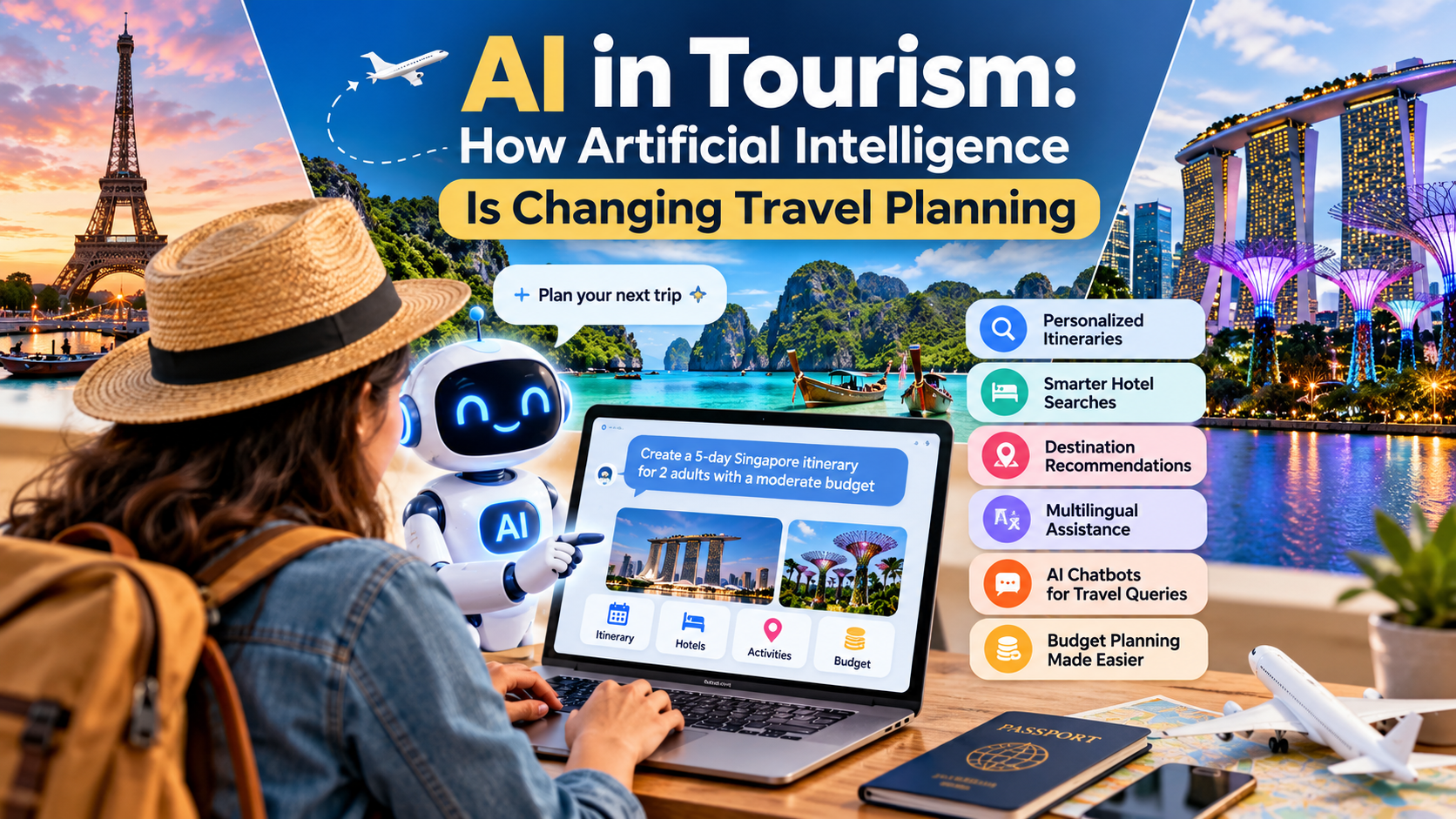
Planning a holiday once meant opening dozens of browser tabs—comparing flights, reading hotel reviews, checking opening hours, saving maps and building an itinerary by hand. Today, artificial intelligence is making that process faster, more personal and far less overwhelming.
With AI, you can ask for a five-day Singapore plan for a family, request vegetarian-friendly restaurants in Bangkok, compare hotels based on your priorities, or get help understanding a menu in Japanese. AI does not remove the need to check details or make final decisions, but it can take much of the initial research off your plate.
That is the real promise of AI in tourism: not replacing travel agents or human expertise, but helping travellers and tourism businesses organise information, discover options and save time.
What Is AI in Tourism?
AI in tourism means using artificial intelligence to support different parts of the travel journey—from inspiration and research to booking, customer service and on-trip assistance.
These tools can understand natural-language questions, analyse large amounts of information, recognise patterns and generate useful suggestions. For example, you could ask an AI assistant:
“Plan a four-day Bangkok trip for two adults on a moderate budget, including temples, street food, shopping and airport transfers.”
The AI might create a draft itinerary, group attractions by area, suggest places to eat and highlight activities that may need advance booking. You can then refine it by adding preferences such as vegetarian food, accessible transport or a slower pace.
But AI-generated travel plans are not automatically accurate. Prices, opening hours, visa rules, transport schedules and availability can change quickly, so travellers should always verify important details through official or trusted sources.
AI in tourism commonly includes:
- Generative AI: Creates itineraries, destination ideas, summaries and personalised recommendations.
- Machine learning: Helps businesses forecast demand, understand customer preferences and improve pricing decisions.
- Chatbots and virtual assistants: Answer common questions and provide automated customer support.
- Recommendation systems: Suggest hotels, attractions, restaurants and experiences based on preferences.
- Language technology: Translates text, summarises reviews and helps travellers communicate across languages.
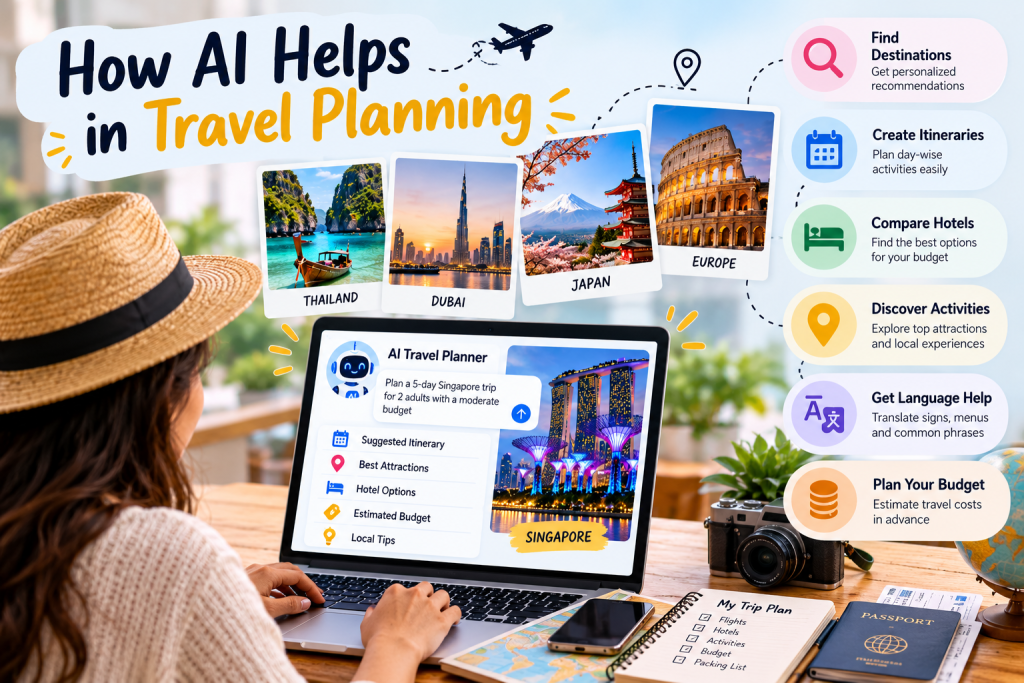
7 Ways AI Is Changing Travel Planning
1. Personalised Travel Itineraries
One of the most useful applications of AI is turning scattered research into a structured travel plan.
Instead of reading dozens of blogs and forums, travellers can describe their trip in plain language: destination, dates, budget, interests, hotel location and travel style. An AI assistant can then prepare a first-draft itinerary.
For example, a family visiting Singapore could ask for a three-day plan covering Gardens by the Bay, Sentosa and other family-friendly attractions. The AI could group nearby activities together, suggest a sensible daily flow and flag experiences that may require advance tickets.
The traveller still needs to check travel times, ticket prices, weather, opening hours and availability. But AI can make the planning process feel much less intimidating.
For travel companies, the same technology can help agents prepare initial itineraries faster and tailor packages to different customer needs.
2. AI Chatbots for Travel Queries
Most travellers ask similar questions before booking:
- What is included in the tour?
- Is airport pickup available?
- Are children allowed?
- What is the cancellation policy?
- Can I book a private transfer?
AI chatbots can answer many of these questions instantly through a travel website or messaging platform. A traveller browsing a site at midnight, for instance, could ask whether an airport transfer from Bangkok’s Suvarnabhumi Airport to their hotel is available.
A well-designed chatbot connected to accurate company information can explain services, luggage limits, booking steps and policies. If it is connected to a live reservation system, it may also check availability. Without that connection, it should not claim that a vehicle, room or tour is available.
For small travel agencies, a simple chatbot can handle frequently asked questions and pass complex requests to a human team member.
3. Smarter Destination Recommendations
AI can help travellers discover places and experiences that actually match their interests.
Someone interested in culture may be shown heritage walks, museums, food tours and traditional performances rather than a generic list of nightlife options. A couple planning a Thailand holiday could ask AI to compare Phuket and Krabi based on beaches, island trips, transport and overall holiday style.
The technology can create a useful starting point, but recommendations are only as good as the information behind them. AI may not know current availability, seasonal conditions, local closures or your personal travel history.
For tourism businesses, recommendation tools can help customers find relevant experiences more easily—provided the suggestions are based on real products and transparent information.
4. Easier Hotel Search and Comparison
Choosing a hotel often involves comparing location, price, facilities, cancellation terms and hundreds of reviews. AI can make this easier by understanding more natural search requests.
Booking.com has introduced AI-powered features including Smart Filters, Property Q&A and AI-generated Review Summaries. Smart Filters allow travellers to describe the kind of stay they want in their own words, while Property Q&A helps users ask specific questions about a property.news.booking
For example, a traveller could search for a Singapore hotel with family rooms, breakfast, easy metro access and a central location. AI can help narrow the options, but the traveller should still review the final price, taxes, cancellation policy and recent guest feedback before booking.
5. Multilingual Travel Assistance
Language barriers can make international travel stressful, especially when you need directions, want to order food or need to explain something urgent.
AI translation tools can help travellers translate menus, signs, messages and basic conversations. An Indian traveller in Japan, for example, could use a translation app to understand a restaurant menu or communicate a dietary requirement. A traveller in Thailand could prepare a translated message with their hotel address for a taxi driver.
Voice translation can also help with simple exchanges, though accuracy may vary with accents, background noise and context. For medical, legal or safety-related information, always double-check the translation.
AI is also being used at scale in Indian tourism. The government’s Kumbh Sah’AI’yak chatbot, launched for Maha Kumbh 2025, provided multilingual, voice-enabled assistance to visitors. Powered by BHASHINI, it supported 11 languages, including Hindi and English.pib.gov+1
6. Better Planning With Real-Time Information
Travel plans rarely survive contact with reality. Flights get delayed, rain arrives, attractions close early and traffic changes everything.
AI can help travellers adapt when it has access to reliable, current information. If rain disrupts an outdoor sightseeing day in Singapore, an AI assistant could suggest indoor alternatives such as museums or covered attractions. The traveller would still need to check opening hours, tickets and transport.
Expedia Group introduced its experimental AI travel assistant, Romie, in 2024, positioning it as a tool to support itinerary planning and help travellers respond to unexpected changes.expedia
The key point is this: AI can suggest alternatives, but it cannot always confirm live facts. For flight delays, transport disruptions and attraction closures, combine AI with airline notifications, official transport apps, weather forecasts and attraction websites.
7. Budget Planning and Cost Management
AI can also help travellers organise a realistic travel budget.
Instead of building a spreadsheet from scratch, you can ask an AI assistant to divide your spending into accommodation, food, transport, attractions, shopping and emergency costs.
For example, if you have ₹30,000 for a three-day Singapore trip, excluding international flights, AI can create a preliminary budget. It may compare a budget hotel with a centrally located hotel, or paid attractions with free experiences.
These figures should be treated as estimates. Your final costs will depend on travel dates, hotel rates, exchange rates, group size and the activities you choose.
For travel businesses, AI can help prepare package cost breakdowns and quotation drafts—but only when supplied with verified supplier prices and company policies.
Practical AI Tools for Travel Planning
You do not need technical skills to start using AI for travel. These tools can support different parts of the journey.
| Tool | Best For | How Travellers Can Use It |
|---|---|---|
| ChatGPT | Itinerary ideas and research | Create destination comparisons, draft daily plans, prepare packing lists and organise travel requirements. |
| Google Gemini | Research and Google workflows | Summarise information and organise travel research, depending on available features and permissions. |
| Google Maps | Navigation and location checks | Check hotel locations, nearby attractions, routes and transport options. |
| Booking.com | Accommodation discovery | Use AI-assisted search and property information to compare stays, where available. news.booking |
| Google Translate | Language assistance | Translate menus, signs, short messages and common travel phrases. |
AI features can vary by country, device, account type and product updates, so it is worth checking what is available before relying on a particular tool.
How Travel Businesses Can Use AI
AI is not just for travellers. Travel agencies, hotels, tour operators and destination organisations can use it to improve everyday operations.
| Business Activity | Practical AI Application |
|---|---|
| Customer enquiries | Draft responses to common questions about transfers, tours and packages. |
| Itinerary preparation | Create first drafts of travel schedules based on customer preferences. |
| Content marketing | Prepare drafts of destination guides, FAQs, emails and social-media posts. |
| Customer segmentation | Group travellers by interests, such as family travel, adventure or budget holidays. |
| Sales support | Prepare personalised quotations using verified supplier prices and approved policies. |
Imagine a small travel company selling activities and airport transfers in Thailand and Singapore. An employee could use AI to draft an itinerary, prepare a quotation template, create destination FAQs and write a follow-up message. The employee would then check supplier availability, confirm prices and approve the final communication.
This approach saves time while keeping important commercial and customer-service decisions under human control.
Businesses should also avoid uploading sensitive data—such as passport details, payment information or confidential customer records—into AI tools without proper authorisation and data-protection safeguards.
Limitations of AI in Tourism
AI can be incredibly helpful, but it is not perfect.
- Incorrect information: AI may produce outdated prices, wrong opening hours or attractions that do not suit your needs.
- Limited local knowledge: Generic recommendations may overlook accessibility needs, local customs, weather or neighbourhood-specific issues.
- Privacy risks: Travel planning can involve personal information, so businesses need strong security controls.
- Dependence on connected systems: Live bookings, flight status and inventory checks require access to reliable data sources.
- Human judgement still matters: Travel agents, local guides and destination experts offer context, experience and support that AI cannot fully replace.
The best approach is to use AI for research, organisation and ideas—then rely on verified information and human judgement for important decisions.
The Future of AI in Travel Planning
AI is likely to become even more integrated into travel as companies connect conversational assistants with booking systems, destination information and customer-service platforms.
Tourism organisations are already experimenting with this approach. Madrid introduced VisitMadridGPT to provide personalised tourism information in multiple languages, while the Tourism Authority of Thailand introduced TATAI as an AI-powered travel companion for destination discovery and trip planning.
In the future, travellers may be able to move more smoothly from describing a holiday to comparing relevant options, managing bookings and receiving support during the trip.
Still, the value of these systems will depend on accurate information, transparent recommendations, privacy protection and the ability to handle unexpected situations.
FAQs About AI in Tourism
What is AI in tourism?
AI in tourism refers to the use of artificial intelligence for itinerary planning, travel recommendations, customer service, translation, hotel search and tourism business operations.
How does AI help with travel planning?
AI can organise research, suggest activities, draft itineraries, summarise accommodation information and help compare options. Travellers should verify important details before booking.
Can AI replace travel agents?
No. AI can automate research and routine tasks, but travel agents remain valuable for complex itineraries, special requirements, supplier coordination and personal judgement.
Is AI travel planning free?
Some AI tools offer free access, while others require a subscription or have usage limits. Booking platforms may also include AI features within their apps.
Is AI-generated travel information reliable?
It can be useful, but it is not always accurate. Always verify visa rules, prices, opening hours, bookings, transport schedules and safety information through official sources.
Conclusion
Artificial intelligence is changing travel planning by making it easier to discover destinations, organise itineraries, compare hotels, overcome language barriers and manage budgets.
For travellers, AI is best used as a smart starting point: draft a Singapore itinerary, compare Dubai experiences or organise a Thailand budget—but confirm the details before booking. For tourism businesses, AI can streamline customer communication, content creation and itinerary preparation when it is used with accurate data and human oversight.
The future of travel planning is not simply about using more AI. It is about combining AI-powered convenience with reliable information, local knowledge and human judgement to create better travel experiences.
References
- Booking.com — Booking.com Enhances Travel Planning with New AI-Powered Features: https://news.booking.com/bookingcom-enhances-travel-planning-with-new-ai-powered-features–for-easier-smarter-decisions/news.booking
- Expedia Group — Put Your Trip on Autopilot: Expedia Group Introduces New AI Features: https://www.expedia.com/newsroom/spring-product-release-2024/expedia
- Press Information Bureau, Government of India — BHASHINI: Transforming Maha Kumbh through Multilingual Innovation: https://www.pib.gov.in/PressReleaseIframePage.aspx?PRID=2093333pib.gov
- Press Information Bureau, Government of India — Maha Kumbh 2025 multilingual AI assistance: https://www.pib.gov.in/PressReleseDetailm.aspx?PRID=2092739pib.gov
- National Geographic — What is noctourism and why it’s on the rise: https://www.nationalgeographic.com/travel/article/what-is-noctourism-rise-of-after-dark-activities