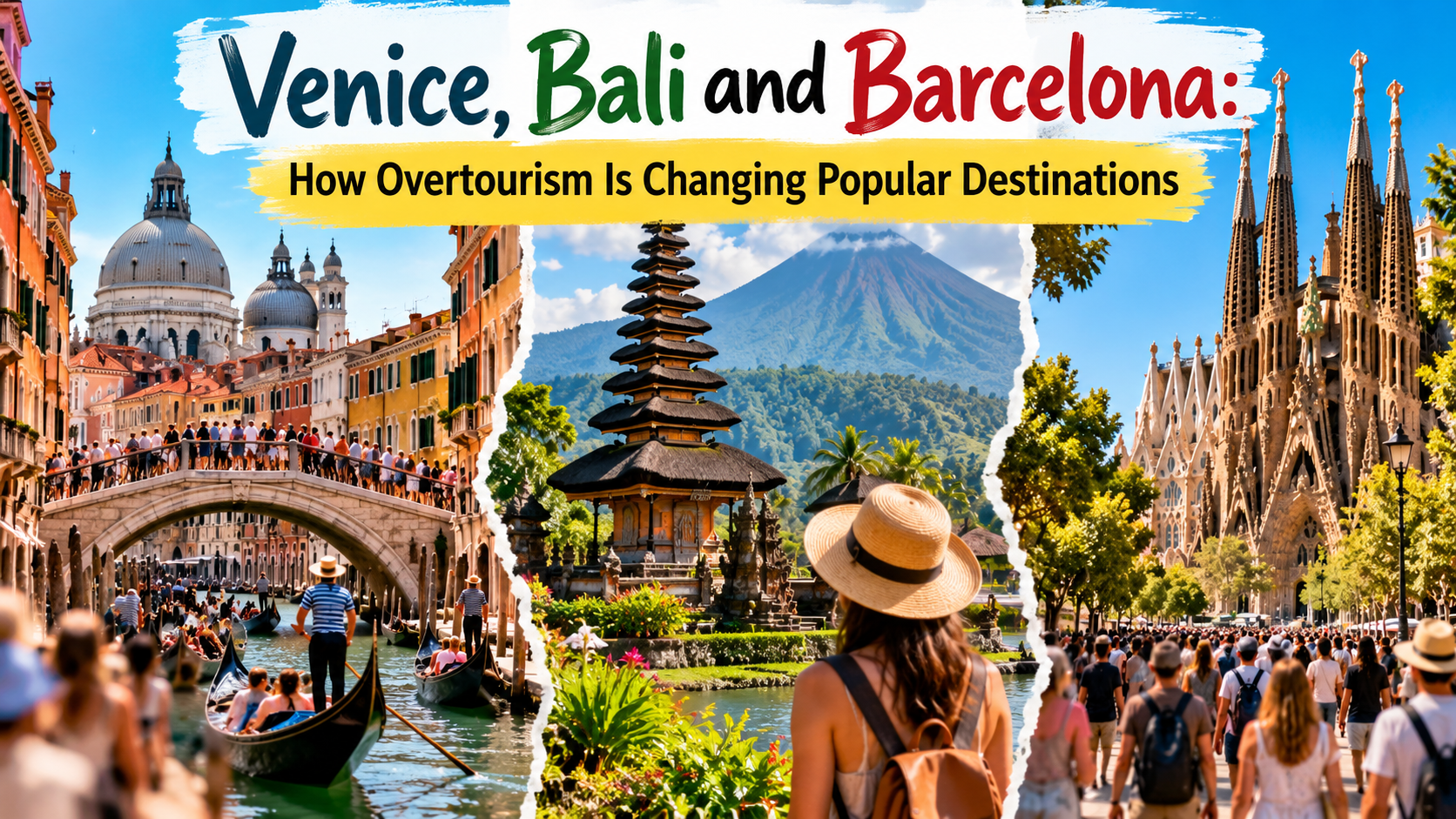
Imagine arriving in Venice to find its famous canals surrounded by crowds, visiting Bali only to encounter traffic jams near its most popular temples, or exploring Barcelona while residents protest the pressure of mass tourism. These experiences reflect a growing challenge for the global travel industry: overtourism.
Travel can support local economies, create jobs, preserve cultural heritage, and connect people across countries. But when visitor numbers grow beyond what a destination can comfortably manage, tourism can place pressure on housing, public infrastructure, natural resources, and residents’ everyday lives.
Overtourism in Venice, Bali and Barcelona has become part of a wider global conversation about sustainable tourism, responsible travel, and the future of popular holiday destinations. This guide explains what overtourism is, why it is increasing, how these three destinations are responding, and how travellers can explore popular places more responsibly.
What Is Overtourism and Why Is It a Global Concern?
Overtourism occurs when the volume or concentration of visitors negatively affects residents’ quality of life, the environment, cultural heritage, or the experience of other travellers.
It is not simply about a destination receiving millions of visitors. The problem often depends on where visitors go, when they arrive, how long they stay, and whether local infrastructure can support the demand. A city may welcome large numbers of tourists without major problems if visitors are spread across seasons, neighbourhoods, and transport systems. But when crowds concentrate in a few streets, beaches, temples, or historic centres, pressure can rise quickly.
The scale of global travel makes this issue increasingly important. UN Tourism recorded an estimated 1.4 billion international tourist arrivals worldwide in 2024, an increase of 11% over 2023 and a return to pre-pandemic levels. Europe alone received 747 million international arrivals in 2024, making it the world’s most visited region.[untourism][e-unwto][france24]
Main causes of overtourism
Several factors contribute to overtourism:
- Social media and viral travel trends: A single photograph, reel, or video can make a beach, viewpoint, café, or neighbourhood popular almost overnight.
- Cruise tourism and day trips: Large numbers of visitors can arrive within a few hours, creating sudden pressure on public spaces while often generating fewer overnight-spending benefits.
- Short-term holiday rentals: High demand for tourist accommodation can intensify competition for housing in some residential neighbourhoods.
- Low-cost transport: Affordable flights, cruise itineraries, and convenient rail connections make international travel accessible to more people.
- Seasonal concentration: Many visitors arrive during the same holidays, weekends, or summer months.
- Concentrated sightseeing: Tourists often visit the same famous attractions rather than exploring less crowded neighbourhoods and surrounding destinations.
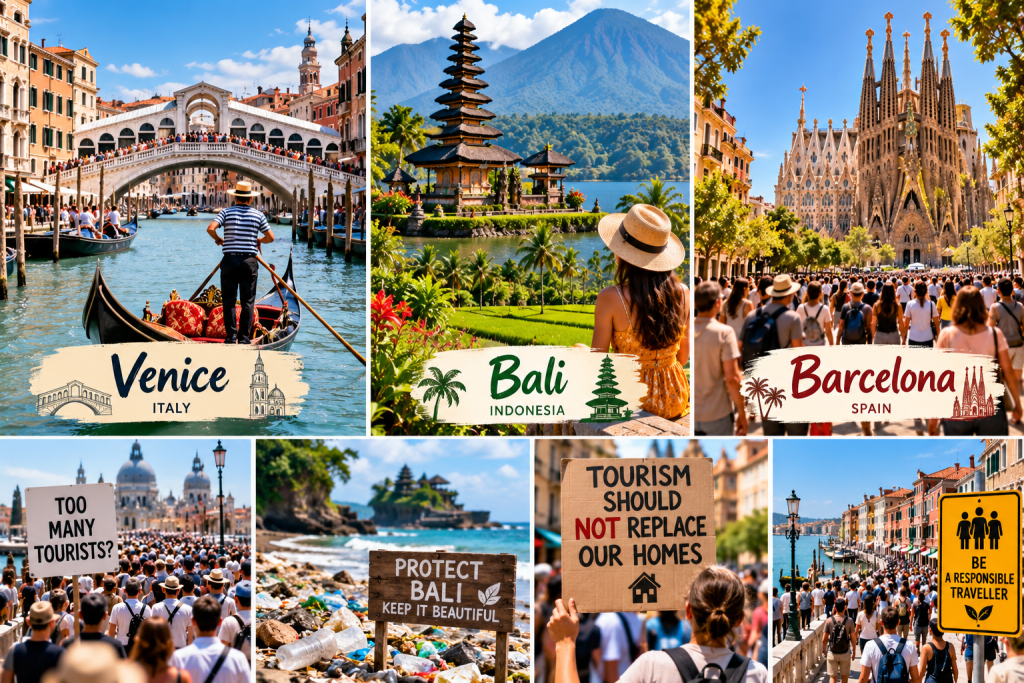
The result is a difficult balancing act. Tourism generates income and employment, but unmanaged growth can weaken the very qualities that made a destination attractive in the first place.
1. Venice, Italy: When a Floating City Faces Too Many Visitors
Venice is one of the world’s most recognisable travel destinations. Its historic canals, gondolas, bridges, narrow streets, and remarkable architecture attract visitors from across the globe.
However, Venice faces a distinctive challenge: its historic centre occupies a limited area, and its narrow streets and pedestrian bridges cannot easily accommodate large crowds. During peak periods, congestion can build around St Mark’s Square, the Rialto Bridge, and the main walking routes connecting major attractions.
How overtourism is changing Venice
Crowded public spaces can make sightseeing less enjoyable for tourists and everyday movement more difficult for residents. Narrow calli, bridges, vaporetto stops, and waterfront areas were not designed for the simultaneous movement of thousands of visitors.
Housing and neighbourhood change are also major concerns. When residential properties are converted into tourist accommodation, some areas can become less accessible to permanent residents. Housing pressures in Venice have multiple causes, but tourism-related demand can intensify competition for limited residential space.
Another issue is the concentration of short visits. Travellers arriving for only a few hours may visit the main landmarks before leaving, creating intense pressure on popular locations while contributing less to the local economy than overnight guests.
What Venice is doing about overtourism
Venice has experimented with an access fee for certain day visitors on selected busy dates. In 2026, the scheme operated on 60 days between April and July, with a standard charge of €5 for advance payment or €10 for later payment, subject to exemptions. The 2026 trial ended on 26 July.[visit.venice]
The fee is intended to help manage visitor flows on peak days, but it is not a strict cap on the number of people entering the city. Travellers planning future visits should check the official Venice Access Fee website for updated dates, exemptions, and payment rules.[visit.venice]
How to explore Venice more responsibly
Visitors can reduce pressure on Venice by making a few simple choices:
- Stay overnight rather than treating Venice as a quick stop.
- Explore quieter neighbourhoods beyond St Mark’s Square and Rialto.
- Visit local bakeries, bacari, artisan workshops, and neighbourhood markets.
- Avoid peak cruise and holiday periods where possible.
- Use public transport responsibly and follow local rules.
Venice’s smaller squares, local food traditions, quieter canals, and residential islands can provide a more meaningful experience than rushing between the city’s most photographed landmarks.
2. Bali, Indonesia: Paradise Under Pressure
Bali has long attracted travellers with its tropical beaches, green rice terraces, Hindu temples, waterfalls, wellness retreats, and distinctive cultural traditions.
The island offers a diverse range of experiences, from surf breaks and beach clubs to village ceremonies and peaceful countryside escapes. Yet its popularity has also created challenges, particularly in areas experiencing rapid tourism development.
How overtourism is changing Bali
Traffic congestion is a familiar concern in heavily visited areas such as Canggu, Seminyak, and parts of Ubud. Short distances can take much longer to cover when roads become crowded, affecting both residents and visitors.
Environmental pressures are another major issue. Tourism creates demand for water, energy, waste collection, and transport. Where infrastructure struggles to keep pace, plastic waste, wastewater management, and pressure on local water resources can become serious concerns.
Tourism-related construction and accommodation growth can also change rural landscapes and put pressure on land use. The effects vary across the island, and not every community experiences tourism in the same way.
Cultural tourism requires care as well. Temples and religious ceremonies are meaningful parts of Balinese life, not simply attractions for photographs. Visitors who ignore dress codes, restricted areas, or local customs can disrupt religious and community activities.
What Bali is doing about overtourism
Bali introduced a foreign tourist levy of IDR 150,000 per person, payable once per trip under the provincial scheme. The contribution is intended to support cultural preservation and environmental protection.[lovebali.baliprov.go][lovebali.baliprov.go]
The levy was introduced from 14 February 2024 and applies to international tourists on their first arrival in Bali, with certain visa and permit categories exempt. Travellers can find payment guidance through the official Love Bali portal.[lovebali.baliprov.go][cgibali.gov]
However, a tourist levy alone cannot solve congestion, waste management, or development pressures. Effective management also requires infrastructure investment, enforcement of regulations, and meaningful involvement of local communities.
How to experience Bali more responsibly
Travellers can help reduce pressure by:
- Staying in locally owned accommodation.
- Visiting less congested areas and traditional villages.
- Choosing licensed local guides.
- Respecting temple etiquette and sacred-site rules.
- Carrying reusable water bottles where safe and practical.
- Avoiding waste and reducing unnecessary driving.
- Spending more time in one area rather than rushing between viral locations.
A slower Bali itinerary can reduce traffic pressure while allowing travellers to understand the island’s culture, landscapes, and communities more deeply.
3. Barcelona, Spain: Balancing Tourism With Everyday City Life
Barcelona combines Mediterranean beaches, striking architecture, vibrant markets, historic neighbourhoods, and a celebrated food culture. From the Sagrada Família to the Gothic Quarter, its attractions appeal to visitors throughout the year.
Tourism is an important part of Barcelona’s economy, supporting hospitality, transport, retail, and cultural activities. At the same time, the concentration of visitors in residential neighbourhoods has prompted debate about how the city should manage its success.
How overtourism is changing Barcelona
One of the biggest concerns is housing affordability. In neighbourhoods where tourist accommodation is concentrated, holiday rentals can contribute to competition for residential properties. However, housing affordability is influenced by wider factors, including construction, housing supply, investment, and local regulation.
Popular streets and attractions can also become congested, while noise and late-night activity may affect residents. Shops that once served local communities can face pressure to cater primarily to visitors, changing the character of neighbourhoods.
The issue is not that tourists are unwelcome everywhere. Rather, it is about ensuring that tourism remains compatible with the needs of people who live and work in the city.
What Barcelona is doing about overtourism
Barcelona has introduced measures to manage tourist accommodation, regulate visitor activity, and improve the balance between tourism and residential life.
The city’s tourism management policies include controls on tourist accommodation through its Special Urban Plan for Tourist Accommodation (PEUAT). Barcelona has also pursued measures to manage high-traffic areas and direct tourism revenue towards public services.[france24]
In 2025, the city continued to develop its approach to tourism management and the preservation of residential neighbourhoods. For the latest policies, consult the official Barcelona tourism management website.[france24]
How to explore Barcelona more responsibly
Visitors can support a healthier tourism model by:
- Exploring neighbourhood markets, local cultural venues, independent shops, and restaurants.
- Using public transport or walking where practical.
- Following local noise rules.
- Choosing legally registered accommodation.
- Visiting major attractions at less crowded times.
- Discovering other parts of Catalonia rather than concentrating every activity in the city centre.
Venice vs Bali vs Barcelona: How Overtourism Affects Each Destination
Although these destinations face a common challenge, the pressures differ according to their geography, infrastructure, and local economies.
| Destination | Major pressure points | Key management priorities |
|---|---|---|
| Venice | Crowded historic streets, day-trip peaks, housing pressure | Visitor-flow management, heritage protection, residential life |
| Bali | Road congestion, waste, water demand, rapid development | Environmental management, infrastructure, cultural respect |
| Barcelona | Housing affordability, neighbourhood congestion, noise | Tourist accommodation regulation, public services, balanced urban tourism |
The comparison shows why there is no single solution to overtourism. A historic island city, a tropical island with varied infrastructure, and a major European metropolis require different strategies.
Policies must reflect local circumstances rather than simply focus on reducing total visitor numbers.
Is Overtourism Changing the Future of Travel?
Yes. The growing debate about overtourism is encouraging destinations, travel businesses, and travellers to reconsider what a successful holiday should look like.
1. The rise of slow travel
Slow travel encourages visitors to spend more time in fewer places. Rather than rushing through a long list of attractions, travellers can explore neighbourhoods, understand local customs, and build more meaningful connections.
A three-night stay in one destination, for example, may provide a more rewarding experience than visiting three cities in the same period.
2. Greater interest in alternative destinations
Travellers are increasingly interested in places beyond the most heavily promoted tourist hotspots. Smaller towns, rural villages, regional food destinations, and lesser-known cultural landscapes can offer distinctive experiences.
However, alternative destinations should not automatically be labelled sustainable. They also need appropriate infrastructure, community participation, and responsible visitor management.
3. More attention to sustainable tourism
Sustainable tourism considers the economic, social, and environmental effects of travel. It aims to support local livelihoods while protecting the resources and cultural heritage that make a destination special.
This can involve choosing local businesses, reducing waste, respecting wildlife, conserving water, and following visitor guidelines.
4. Smarter destination management
Tourism authorities can use visitor data, timed-entry systems, public transport planning, accommodation rules, and better infrastructure to manage pressure on popular locations.
Such measures work best when developed with residents, tourism businesses, and community organisations. A fee or restriction on its own is unlikely to resolve every underlying problem.
7 Practical Ways to Avoid Contributing to Overtourism
Every traveller can make more thoughtful choices without giving up the joy of exploring the world.
- Travel during shoulder seasons: Where weather and local conditions permit, visit outside the busiest holiday periods.
- Stay longer: Reduce rushed itineraries and spend more time understanding one destination.
- Support local businesses: Choose independent restaurants, community guides, and locally owned accommodation.
- Explore beyond famous attractions: Discover other neighbourhoods and nearby destinations without treating residential areas as photo sets.
- Use public transport: Reduce unnecessary car journeys where reliable public transport is available.
- Respect local culture: Follow dress codes, ask permission before photographing people, and observe rules at religious sites.
- Check local tourism regulations: Review entry fees, tourist levies, accommodation rules, and attraction booking requirements before travelling.
These small decisions can help distribute tourism spending more widely and reduce avoidable pressure on popular locations.
Conclusion: Can Tourism and Local Life Coexist?
Venice, Bali, and Barcelona demonstrate that a destination’s popularity can become a challenge when visitor activity grows faster than local systems can manage.
Overtourism affects more than sightseeing. It can influence housing, public spaces, cultural traditions, environmental resources, and the everyday experiences of residents. At the same time, tourism remains an important source of income and employment for many communities.
The solution is not necessarily to stop travelling. It is to travel more thoughtfully and to support policies that balance visitor experiences with local needs.
For travellers, this means spending more time in destinations, supporting local businesses, respecting community rules, and looking beyond the most famous attractions. For tourism authorities, it means investing in infrastructure, protecting residential life, and involving local communities in decisions.
The future of travel will depend not only on where people want to go, but also on how they choose to experience those places. The most rewarding journey is one that leaves a positive contribution behind, rather than adding unnecessary pressure to the destination.
References
- UN Tourism, World Tourism Barometer: 1.4 billion international tourist arrivals recorded globally in 2024.[untourism][e-unwto]
- UN Tourism data reported by AFP: Europe received 747 million international arrivals in 2024; global tourism receipts reached about $1.6 trillion.[france24]
- Venice Access Fee official information: 2026 scheme covered 60 days, with €5 advance-payment and €10 late-payment charges, subject to exemptions.[visit.venice]
- Love Bali official FAQ: foreign tourist levy of IDR 150,000 per person, payable once per trip.[lovebali.baliprov.go]
- Consulate General of India, Bali: Bali’s foreign tourist levy took effect from 14 February 2024.[cgibali.gov]
- Barcelona City Council tourism management information: PEUAT and tourism-management measures.[france24]