Travel in 2026 is becoming more personalized, experience-driven, and purposeful. Instead of simply visiting famous landmarks, travelers are increasingly exploring holidays that reflect their interests, budgets, relationships, and well-being. Artificial intelligence is changing how trips are planned, while rural escapes, community-focused tourism, and unconventional accommodation are attracting attention.
These changes are unfolding in a dynamic global travel market. According to UN Tourism’s September 2026 World Tourism Barometer, approximately 690 million international tourist arrivals were recorded between January and June 2026, representing a 0.4% increase compared with the same period in 2025. Arrivals grew by 2% in the first quarter but declined by 1% in the second quarter.
The figures highlight an important reality: global tourism remains substantial, but growth varies across periods and destinations.
This article explores 15 major tourism trends shaping travel in 2026, drawing on research and industry reports from UN Tourism, Hilton, Expedia Group, and Booking.com. It examines what these trends mean for travelers, hotels, tour operators, and destination marketers.
Note: Survey results indicate respondents’ preferences or intentions, not necessarily completed bookings. Individual trends may be more relevant to certain markets than others.
1. Purpose-Led Holidays Replace Checklist Travel
One of the emerging tourism trends in 2026 is the shift toward holidays planned around personal goals rather than a long list of attractions.
Hilton describes this approach as the “whycation,” where travelers choose trips based on what they want to achieve emotionally or personally, such as reconnecting with family, relaxing, or exploring an interest. Its 2026 trends research involved 14,009 adults across 14 countries.
For example, a couple might choose a peaceful mountain retreat instead of a packed city itinerary, while a family might prioritize shared activities over visiting every major attraction.
What it means for tourism businesses: Hotels and tour operators can market experiences around relaxation, discovery, and connection rather than focusing exclusively on facilities and sightseeing lists.
Source: Hilton 2026 Trends Report
2. Artificial Intelligence Becomes a Travel-Planning Companion
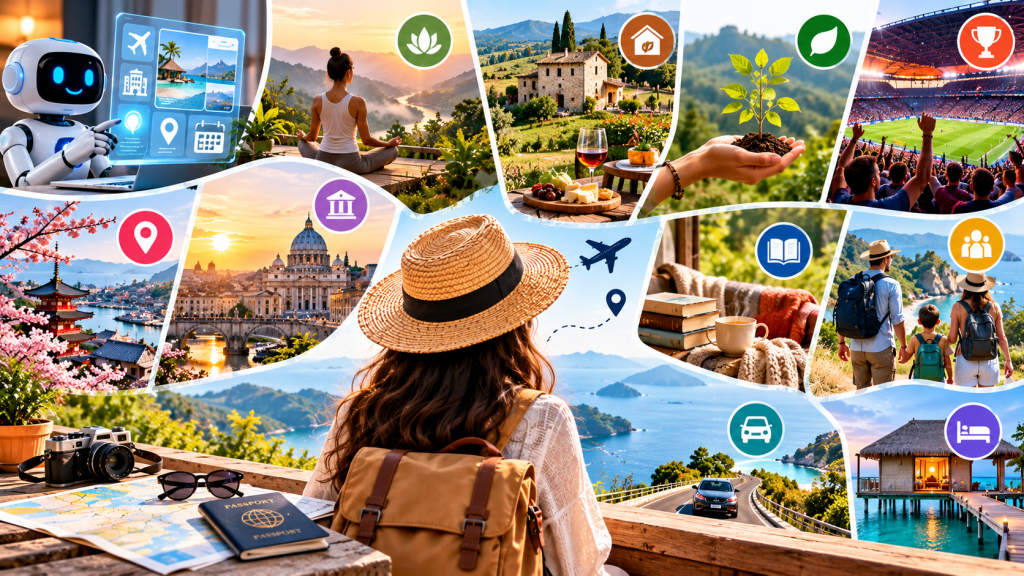
Artificial intelligence is changing how travelers discover destinations, organize itineraries, and research less familiar places.
Booking.com’s 2026 travel predictions found that 65% of surveyed travelers would use AI or generative AI to map scenic, less-traveled routes tailored to their preferences.
For example, a traveler planning a five-day Singapore holiday could ask an AI assistant to group attractions by location, suggest family-friendly activities, and prepare a preliminary budget.
However, AI-generated information should be checked against current ticket prices, opening hours, transport schedules, and official travel requirements.
What it means for tourism businesses: Travel agencies can use AI to prepare itinerary drafts, answer routine questions, and develop personalized proposals, provided staff verify important details before sharing them with customers.
Source: Booking.com — Travel Trends for 2026
3. Wellness Travel Focuses on Rest and Mental Well-Being
Wellness tourism is expanding beyond spa treatments to include holidays designed around rest, nature, and a slower pace of life.
Hilton’s 2026 research found that 56% of respondents identified resting and recharging as a motivation for leisure travel. Meanwhile, 37% wanted to spend time in nature, and 36% wanted to improve their mental health.
A wellness-oriented holiday might involve nature walks, flexible schedules, peaceful accommodation, or time away from daily responsibilities.
What it means for tourism businesses: Accommodation providers can highlight green spaces, quiet surroundings, flexible dining, and opportunities for relaxation without making unsupported medical claims about their services.
Source: Hilton 2026 Trends Report
4. Quiet Escapes and Digital Disconnection Gain Appeal
Closely related to wellness travel is the growing interest in peaceful environments and fewer digital distractions.
Hilton calls this trend “hushpitality,” emphasizing the appeal of quiet spaces and relief from everyday noise.
A traveler does not necessarily need to visit a remote retreat to enjoy this experience. A peaceful hotel room, an unhurried breakfast, or a countryside weekend with limited screen time may provide the desired change of pace.
Business opportunity: Hotels can communicate specific features, such as quiet rooms, gardens, reading spaces, and low-distraction activities, instead of relying on vague descriptions such as “perfectly tranquil.”
Source: Hilton — Hushpitality
5. Slow Travel Expands into Rural and Farm Experiences
Slow travel encourages visitors to spend more time in a destination and engage more deeply with local surroundings.
Expedia Group’s Unpack ’26 report found that 84% of surveyed travelers expressed interest in staying on or near a farm. Farm-related mentions in Vrbo guest reviews also increased by 300% across the report’s comparison periods.
Farm stays may offer opportunities to explore walking trails, learn about local food production, or experience rural life.
These experiences appeal to travelers seeking a different pace from traditional city breaks. However, increased interest in farm accommodation does not mean urban holidays are disappearing.
Business opportunity: Rural accommodation providers can create authentic experiences around local food, regional traditions, nature, and community activities.
Source: Expedia Group — Unpack ’26
6. Lesser-Known Destinations Attract More Attention
Travelers are exploring alternatives to familiar international hotspots, with destination discovery increasingly extending to smaller cities, coastal communities, and rural regions.
Expedia’s 2026 destination analysis highlighted growing search interest in places including Okinawa in Japan, Ucluelet in Canada, the Cotswolds in England, and Hobart in Australia.
Search interest indicates curiosity rather than confirmed increases in tourist arrivals. Nevertheless, it can help identify places attracting attention from potential visitors.
The broader issue is how destinations manage growth while protecting local communities and the environment.
Business opportunity: Travel companies can introduce lesser-known destinations through regional itineraries, local guides, and experiences that distribute tourism beyond heavily visited attractions.
Source: Expedia Group — Unpack ’26
7. Sustainable Tourism Becomes More Community-Focused
Sustainable tourism increasingly considers the effects of travel on local residents alongside environmental protection.
Booking.com’s 2025 Travel & Sustainability research found that 53% of respondents were conscious of tourism’s effects on local communities as well as the environment. Additionally, 73% wanted their spending to benefit local communities.
Examples include booking locally owned accommodation, purchasing regional products, and hiring independent guides.
However, stated intentions do not always translate into purchasing behavior. Businesses should therefore communicate their local partnerships and sourcing practices clearly.
Business opportunity: Tour operators can work with local suppliers and explain how particular experiences support regional businesses, rather than relying on broad sustainability claims.
Source: Booking.com — 2025 Travel & Sustainability Report
8. Sports Tourism Becomes a Cultural Experience
Sports travel is extending beyond major international tournaments to include regional sporting traditions and local events.
Expedia’s research found that 57% of surveyed travelers were likely to attend a regional sporting experience while traveling. The figure rose to 68% among its combined Gen Z and millennial group.
Examples include watching sumo in Japan, hurling in Ireland, or lucha libre wrestling in Mexico.
These activities can provide insights into local traditions, community identity, and sporting culture.
Business opportunity: Tourism businesses can combine event attendance with cultural explanations, neighborhood tours, local food, and practical guidance on spectator etiquette.
Source: Expedia Group — Unpack ’26
9. Films and Television Continue to Inspire Travel
Screen-inspired tourism, often called “set-jetting,” involves visiting destinations featured in films and television shows.
Expedia’s research found that 53% of respondents said their desire to take a screen-inspired trip had increased during the previous year.
The appeal comes from visiting places that viewers already recognize from stories and characters they enjoy.
For destinations, this creates opportunities to connect filming locations with local history, architecture, food, and cultural attractions.
Business opportunity: Tour operators can develop screen-inspired itineraries while ensuring that filming-location information is accurate and that visitors respect residential areas.
Source: Expedia Group — Unpack ’26
10. Reading Retreats Offer a Different Kind of Holiday
Reading retreats are an alternative to activity-heavy travel, allowing visitors to prioritize books, relaxation, and time with friends or family.
Vrbo’s “Readaways” trend reflects interest in holidays organized around reading. Its report also found that reading-related terms in guest reviews nearly tripled.
A reading retreat might involve renting a countryside property with friends, spending time in a quiet coastal cottage, or enjoying an accommodation with comfortable shared spaces.
Business opportunity: Property owners can highlight libraries, reading corners, peaceful surroundings, gardens, and comfortable communal areas to appeal to guests seeking slower holidays.
Source: Expedia Group — Unpack ’26
11. Heritage Hotels Turn Accommodation into an Attraction
Accommodation is increasingly becoming part of the travel experience rather than simply a place to sleep.
Hotels.com’s “Salvaged Stays” analysis highlighted interest in properties converted from historic buildings, including former schools, banks, and railway stations.
These properties offer distinctive architecture and a connection to the history of a destination.
However, converting a historic building into a hotel does not automatically demonstrate strong environmental performance. Sustainability depends on the building’s actual design, operations, and resource use.
Business opportunity: Heritage properties can differentiate themselves through architectural stories, historical interpretation, and locally inspired guest experiences.
Source: Expedia Group — Unpack ’26
12. Hotel Hopping Creates Flexible Accommodation Choices
Instead of staying in one hotel throughout a holiday, some travelers are booking multiple properties within the same destination.
Hotels.com’s research found that 54% of surveyed travelers were booking multiple hotels during a single destination visit. Exploring different neighborhoods and finding better deals were leading motivations.
For example, a traveler might spend the first few nights in a centrally located hotel before moving to a quieter coastal or residential area.
This approach can offer variety, but it also involves packing, transfers, check-in procedures, and time spent moving between properties.
Business opportunity: Hotels can highlight neighborhood experiences and provide clear information about transport connections to help guests decide where to stay.
Source: Expedia Group — Unpack ’26
13. Family Holidays Become More Flexible
Family travel does not always involve the same group composition, schedule, or activity preferences.
Hilton’s 2026 trends report uses the term “Generation Permutations” to describe changing family travel combinations and the desire for shared experiences.
Some families may travel across generations, while others may prefer smaller groups or arrangements that allow different members to pursue separate activities.
Business opportunity: Hotels and tour operators can offer flexible room arrangements, adaptable schedules, and experiences that accommodate different ages and activity levels.
The objective is to make shared travel more convenient without requiring every family member to follow an identical itinerary.
Source: Hilton 2026 Trends Report
14. Road Trips Offer Greater Control Over Travel
Road trips provide flexibility over departure times, routes, stops, and travel pace.
Hilton’s 2026 research highlights renewed interest in US road trips, connecting them with familiar comforts, shared adventures, and travel with pets.
Road travel can also introduce visitors to smaller towns and attractions between major destinations.
However, the reported trend is specifically framed around the United States and should not be treated as proof of a worldwide road-trip boom.
Business opportunity: Accommodation providers and local tourism businesses can appeal to road travelers through convenient parking, pet-friendly options where available, and information about nearby attractions.
Source: Hilton 2026 Trends Report
15. Travel Value Means More Than the Lowest Price
Price remains important, but travelers also consider reliability, location, convenience, and whether an experience matches their needs.
Hilton reported that 74% of respondents valued booking with brands they knew and trusted. Meanwhile, Hotels.com’s research found that better deals motivated 35% of hotel hoppers.
Together, these findings suggest that travelers may balance affordability with familiarity and confidence.
For example, a slightly more expensive hotel with convenient transport and transparent cancellation conditions may offer better overall value than a cheaper property in a less suitable location.
Business opportunity: Hotels, travel agencies, and tour operators should explain inclusions, exclusions, service quality, and cancellation conditions clearly instead of relying entirely on discounts.
Source: Expedia Group — Unpack ’26
What Do These Tourism Trends Mean for 2026?
The common theme connecting these 15 tourism trends is more intentional travel. Travelers are exploring ways to align holidays with personal interests, relationships, budgets, and preferred experiences.
AI can simplify preliminary research, while wellness retreats, rural stays, sports experiences, and screen-inspired journeys provide different reasons to travel. Accommodation is also becoming part of the experience through heritage buildings, flexible hotel choices, and quieter environments.
For tourism businesses, the implications are practical:
- Personalize offers: Develop itineraries around specific traveler interests and trip purposes.
- Use AI responsibly: Automate routine tasks while verifying prices, schedules, and availability.
- Promote local experiences: Work with independent guides, regional suppliers, and community businesses.
- Communicate value clearly: Explain what customers receive, including limitations and additional costs.
- Avoid overgeneralization: Consumer surveys and online searches are useful indicators, but they do not automatically predict actual bookings.
UN Tourism’s 2026 arrival statistics also underline the importance of interpreting trends alongside market conditions. International tourism recorded 690 million arrivals during the first half of 2026, but quarterly growth varied. Industry decisions should therefore consider destination-level demand, seasonality, and local capacity.
Ultimately, the future of tourism is unlikely to be defined by one universal holiday style. Instead, businesses that understand different traveler needs and deliver credible, relevant experiences will be better positioned to respond to changing demand.
Frequently Asked Questions About Tourism Trends in 2026
What are the biggest tourism trends in 2026?
Major trends include purpose-led holidays, AI-assisted travel planning, wellness tourism, quiet escapes, rural stays, lesser-known destinations, community-focused sustainability, sports tourism, and flexible accommodation choices.
How is AI changing the tourism industry?
AI helps travelers organize itineraries, discover destinations, and prepare preliminary travel plans. Tourism businesses can use it for content creation, customer enquiries, and itinerary drafts, but important details should be verified before customers make decisions.
Is sustainable tourism becoming more important?
Consumer research indicates interest in environmental and community impacts. However, reported preferences should not be confused with verified purchasing behavior or measured sustainability outcomes.
Why are travelers choosing lesser-known destinations?
Travelers may be attracted by different scenery, local culture, quieter surroundings, or experiences outside familiar tourism hotspots. Increased search interest indicates discovery potential, not necessarily confirmed growth in arrivals.
What do tourism trends mean for travel businesses?
They highlight opportunities to personalize products, communicate value, use technology carefully, support local suppliers, and create experiences suited to different customer needs.
References and Research Methodology
This article draws on the following published research and industry sources:
- UN Tourism. World Tourism Barometer — September 2026. International arrival estimates for the first half of 2026.
https://en.unwto-ap.org/news/world-tourism-barometerseptember2026/ - Hilton. 2026 Trends Report. Research covering 14,009 adults across 14 countries, based on an Ipsos online survey conducted in June 2025.
https://stories.hilton.com/2026-trends - Hilton. Hushpitality: Seeking Sweet Silence. Research on quiet escapes, rest, and well-being.
https://stories.hilton.com/2026-trends/hushpitality-seeking-sweet-silence - Expedia Group. Unpack ’26. Research and platform insights covering accommodation preferences, destination interest, sports tourism, screen-inspired travel, and hotel hopping. The report includes OnePoll research involving 24,000 adults across 18 countries.
https://www.expedia.com/newsroom/unpack-26-expedia-hotelscom-vrbo/ - Booking.com. The Era of You: Travel Predictions for 2026. Research on personalization and AI-assisted travel planning.
https://news.booking.com/the-era-of-you-bookingcom-predicts-the-top-trends-defining-travel-in-2026-with-individuality-taking-center-stage/ - Booking.com. 2025 Travel & Sustainability Report. Research on traveler attitudes toward environmental and community impacts.
https://news.booking.com/download/487ae9ae-97ef-4f66-b368-3b71787677b6/2025travelampsustainabilityreport-booking.com2.pdf
Methodology note: This article combines official international arrival estimates, consumer survey responses, and travel-platform search or review data. These sources measure different things and should not be interpreted as interchangeable. Survey results reflect the respondents studied, and platform activity does not necessarily represent total destination arrivals.